

Blackwood
acacia melanoxylon
The Blackwood (Acacia melanoxylon), also known as the Australian Blackwood, is a majestic evergreen tree native to eastern Australia. Renowned for its exceptionally high-quality timber, which boasts rich, dark tones similar to walnut, this tree is highly prized by woodworkers and luthiers worldwide for making fine furniture and musical instruments. Beyond its economic value, the Blackwood plays a critical ecological role in its native temperate rainforests and wet sclerophyll forests, offering vital shelter and food to a diverse array of native wildlife. Highly adaptable, the Blackwood can grow as a towering canopy tree in wet, sheltered gullies or as a smaller, hardier shrub in drier, exposed coastal regions. Its ability to fix nitrogen enriches the soil, facilitating the growth of surrounding plant species and contributing to the overall health and succession of its forest ecosystem.
Lebensraum: Found in wet sclerophyll forests, temperate rainforest margins, and coastal woodlands, often thriving in fertile, moist soils along river banks.
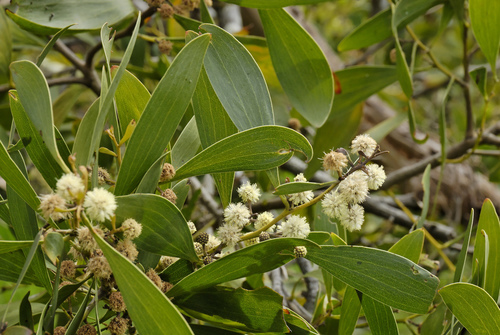
The Blackwood is a medium to large tree, reaching heights of 10 to 35 meters, characterized by a dense, symmetrical crown of dark green foliage. Interestingly, what appear to be leaves are actually flattened leaf stalks called phyllodes, which are lance-shaped, slightly curved, and feature prominent longitudinal veins. In late winter and spring, the tree bursts into color with clusters of pale yellow to cream-colored globular flower heads. The bark is dark grey to black, deeply fissured, and rough to the touch, contrasting beautifully with the twisting reddish-brown seed pods that split open to reveal black seeds encircled by bright pinkish-red stalks.
Kategorie
PflanzenSeltenheit
Common
Gefahr
1/5 · Sehr gering
Snaps
Mach den ersten Snap!
Indigenous Australians historically used the bark of the Blackwood to make string, shields, and throwing sticks, and infused the bark in water to treat rheumatism.
The beautiful, highly figured wood of the Blackwood is prized worldwide for crafting premium acoustic guitars and fine furniture.
The bright red, fleshy cord wrapping around the black seed mimics a worm to trick birds into eating and dispersing the seeds.
Modified leaf petioles called phyllodes function as leaves, reducing water loss while maximizing photosynthetic efficiency in diverse climates.
Hosts symbiotic rhizobia bacteria in its root system to convert atmospheric nitrogen into usable soil nutrients, enriching poor soils.
Produces tough seeds that can remain dormant in the soil for decades, germinating rapidly after the heat of a forest fire clears the canopy.
As a photosynthetic plant, the Blackwood synthesizes its own food using sunlight, water, carbon dioxide, and nutrients absorbed from the soil.
Pseudocheirus peregrinus
The leaves and young shoots of the Blackwood provide a vital food source for this native Australian marsupial.
Apis mellifera
Feeds on the nectar of the pale yellow blossoms, acting as a primary pollinator during winter and spring.
Platycercus elegans
Birds eat the seeds, attracted by the bright red arils, and subsequently disperse them across the forest.
Für dieses Objekt sind noch keine Merkmal-Badges vergeben.
Noch keine Alternativnamen vorhanden.
Sammlungen für dieses Objekt erscheinen hier, wenn weitere Themen hinzugefügt werden.
Gefahr
1/5 · Sehr gering
Noch keine besonderen Sicherheitshinweise.
Der einfachste Weg, Blackwood zu bestimmen, ist die Verwendung der Naturführer-App Snappit.
1000-3500 cm
1500-12000 kg
50-150 Jahre
As a photosynthetic plant, the Blackwood synthesizes its own food using sunlight, water, carbon dioxide, and nutrients absorbed from the soil.
Found in wet sclerophyll forests, temperate rainforest margins, and coastal woodlands, often thriving in fertile, moist soils along river banks.
Zoome hinein, um Cluster aufzulösen und zu sehen, wo dieses Objekt fotografiert wurde.
Neueste Snaps erscheinen hier, wenn neue Beobachtungen hinzukommen.