

Blue-Foot
psilocybe caerulipes
The Blue-Foot (Psilocybe caerulipes) is a fascinating and relatively rare mushroom species, highly regarded for its distinctive appearance and unique properties. Native to specific hardwood forest ecosystems, this fungus plays a vital role as a saprobe, breaking down decaying wood and returning essential nutrients to the forest floor. What truly sets the Blue-Foot apart is its characteristic blue bruising, particularly on its stem, a clear indicator of the presence of psychoactive compounds. Its elusive nature and specific habitat requirements make it a prized find for mycologists and mushroom enthusiasts, offering a glimpse into the complex biochemical world of fungi.
Lebensraum: Found primarily in hardwood forests, often growing solitarily or in small groups on decaying deciduous wood, logs, branches, and wood chips, particularly favoring oak and maple.
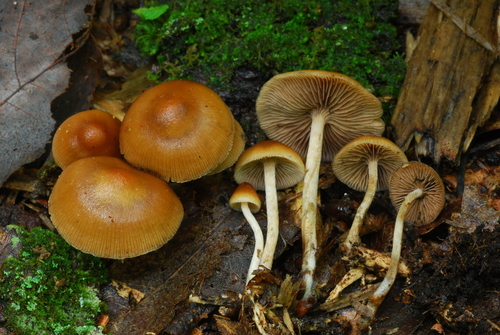
The Blue-Foot mushroom typically features a cap that ranges from 1 to 4 cm in diameter, initially convex and becoming broadly convex to plane with age, often with a slight central depression. Its color varies from cinnamon-brown to yellowish-brown when moist, fading to a lighter tan or buff as it dries. The most distinguishing feature is the stipe (stem), which is slender, 3 to 10 cm tall, and often exhibits a striking blue or bluish-green discoloration, especially towards the base, when handled or damaged. The gills underneath the cap are closely spaced, initially pale and becoming dark purplish-brown with age, sometimes mottled.
Kategorie
PilzeSeltenheit
Common
Gefahr
1/5 · Sehr gering
Snaps
Mach den ersten Snap!
It is often considered one of the rarer psychoactive Psilocybe species found in the northeastern United States, making it a sought-after find for mycologists.
The 'blue-foot' name refers to the prominent blue staining that occurs on the stem (stipe) when the mushroom is bruised or damaged.
The bluing reaction is caused by the oxidation of psilocin, one of the psychoactive compounds present in the mushroom, upon exposure to air.
Unlike many other fungi, Psilocybe caerulipes is not mycorrhizal; it is a saprobe, meaning it feeds on decaying wood rather than forming a symbiotic relationship with live tree roots.
This species produces psilocybin and psilocin, psychoactive compounds responsible for its characteristic bluing reaction when bruised or damaged, indicating its unique chemical makeup.
As a saprobic fungus, it efficiently breaks down lignin and cellulose in dead hardwood, playing a crucial role in nutrient cycling and organic matter decomposition within its forest ecosystem.
Like other mushrooms, the Blue-Foot releases millions of microscopic spores into the air, facilitating its reproduction and dispersal across suitable decaying wood substrates.
The Blue-Foot is a saprobic fungus, meaning it obtains its nutrients by decomposing dead organic matter. It secretes enzymes that break down complex organic compounds in wood into simpler molecules, which it then absorbs.
Quercus rubra
Provides substrate for decomposition
Acer saccharum
Provides substrate for decomposition
Mycetophilidae
Consumes fungal tissue, aiding in spore dispersal
Für dieses Objekt sind noch keine Merkmal-Badges vergeben.
Noch keine Alternativnamen vorhanden.
Sammlungen für dieses Objekt erscheinen hier, wenn weitere Themen hinzugefügt werden.
Gefahr
1/5 · Sehr gering
Noch keine besonderen Sicherheitshinweise.
Der einfachste Weg, Blue-Foot zu bestimmen, ist die Verwendung der Naturführer-App Snappit.
3-10 cm
The Blue-Foot is a saprobic fungus, meaning it obtains its nutrients by decomposing dead organic matter. It secretes enzymes that break down complex organic compounds in wood into simpler molecules, which it then absorbs.
Found primarily in hardwood forests, often growing solitarily or in small groups on decaying deciduous wood, logs, branches, and wood chips, particularly favoring oak and maple.
Foraging
Zoome hinein, um Cluster aufzulösen und zu sehen, wo dieses Objekt fotografiert wurde.
Neueste Snaps erscheinen hier, wenn neue Beobachtungen hinzukommen.