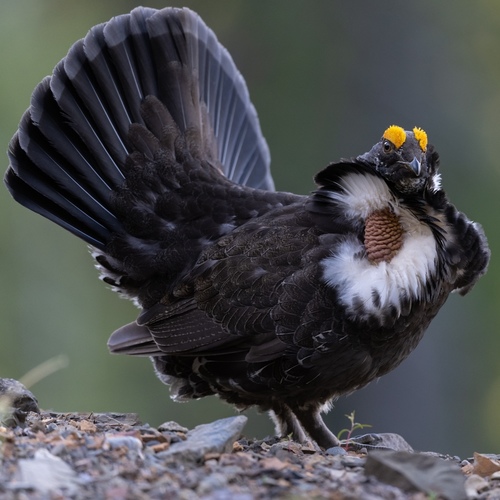


Blue Grouse
dendragapus
The Blue Grouse, belonging to the genus Dendragapus, is a hardy and fascinating forest bird native to the mountainous regions of western North America. Renowned for its remarkable seasonal behaviors, this montane species performs an inverted altitudinal migration, moving uphill to spend harsh winters in high-elevation conifer forests before descending to breed in lowland foothills. During the spring mating season, males capture attention with their elaborate courtship displays, fanning their dark tails and producing resonant, low-frequency hoots from brightly colored, inflatable neck air sacs. This species plays a key role in its native ecosystems as both a consumer of forest vegetation and a vital food source for top-tier predators.
Lebensraum: Found in mountain coniferous and mixed-conifer forests, often transitioning to open alpine meadows during the breeding season.
This stocky, chicken-like bird has a dark, dusky gray to brownish plumage heavily mottled with white and brown along the flanks. Males feature a dark tail with a prominent light gray band at the tip, accompanied by yellow-to-orange combs over their eyes and inflatable yellow-orange or reddish throat sacs visible during mating displays. Females are slightly smaller and more cryptically colored in intricate shades of brown, gray, and black, which perfectly camouflage them against the forest floor and nesting sites.
Kategorie
VögelSeltenheit
Common
Gefahr
1/5 · Sehr gering
Snaps
Mach den ersten Snap!
During the winter, Blue Grouse grow specialized comb-like fringes of skin along their toes that act as natural snowshoes, helping them walk across deep snowpacks.
The low-frequency courtship call of the male is so deep that human hikers often feel the thumping vibration in their chest before they can actually hear the sound.
They undergo an 'upside-down' migration, travelling uphill to harsh mountain peaks for winter, whereas most other birds migrate south or fly down to warmer valley floors.
Unlike most migratory birds, this species travels to higher, colder elevations for the winter to roost in dense pine trees and descends to warmer valleys for the summer breeding season.
Males inflate specialized esophageal air sacs to generate extremely low-frequency hoots that vibrate through dense forest, signaling to females over vast distances.
They possess an elongated cecum containing specialized microbes that allow them to efficiently extract nutrients from tough, resinous pine and fir needles during the winter months.
Feeds primarily on conifer needles and buds during winter, while shifting to insects, seeds, and berries during the warmer spring and summer months.
Accipiter gentilis
Adult grouse are a major winter prey source for this agile forest raptor.
Pseudotsuga menziesii
Provides the primary food source (needles and buds) and winter shelter for the grouse.
Canis latrans
Preys upon nesting females, chicks, and eggs on the forest floor.
Für dieses Objekt sind noch keine Merkmal-Badges vergeben.
Noch keine Alternativnamen vorhanden.
Sammlungen für dieses Objekt erscheinen hier, wenn weitere Themen hinzugefügt werden.
Gefahr
1/5 · Sehr gering
Noch keine besonderen Sicherheitshinweise.
Der einfachste Weg, Blue Grouse zu bestimmen, ist die Verwendung der Naturführer-App Snappit.
Feeds primarily on conifer needles and buds during winter, while shifting to insects, seeds, and berries during the warmer spring and summer months.
Found in mountain coniferous and mixed-conifer forests, often transitioning to open alpine meadows during the breeding season.
Foraging201d3f3f03b86cb4f19bc306c5270220915f01e19d70081d64c12217f7c46f14064d7c6f06fc3268841dfa7d84bd30a108b98b9e6973e20bfd7ee974f0c977fdbec510bf22fbda7169f98ca78e87b7a63529323c683b56cfc8b0c6a5a0d33e9d48b1116a445d4e7ef6cfdb60dfb190f84576ff2a7e44e21a8da0b1e4c76b9e11fc414c1eb4fc8f553f191b7e411b066cf8b553e191b7e411b06c8b553e191b7e411b06c8b553e191b7e411b06
5+
Zoome hinein, um Cluster aufzulösen und zu sehen, wo dieses Objekt fotografiert wurde.
Neueste Snaps erscheinen hier, wenn neue Beobachtungen hinzukommen.














