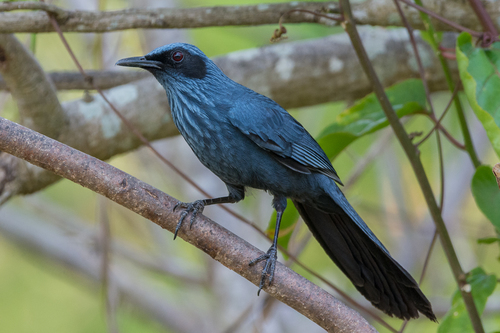


Blue Mockingbird
melanotis caerulescens
The Blue Mockingbird is a striking and charismatic songbird endemic to Mexico, occasionally delighting birdwatchers with rare wanderings into the southern United States. Belonging to the mimic thrush family (Mimidae), this medium-sized bird is renowned for its exceptional vocal talents and secretive nature. Rather than singing from exposed high perches, it prefers the deep, tangled undergrowth, filling the thickets with a rich, complex medley of its own whistles mixed with clever imitations of other birds and environmental sounds. With its gorgeous dusky-blue plumage and contrasting dark mask, the Blue Mockingbird is a highly sought-after species for nature enthusiasts and ornithologists alike. Its skulking habits make spotting one a thrilling challenge, but its distinctively harsh scolding calls and gorgeous, fluid songs often betray its hidden location in dense subtropical scrub.
Lebensraum: Typically found in dense subtropical dry forests, humid evergreen forest edges, and second-growth scrubby woodlands.
Adults are instantly recognizable by their uniform, dark slate-blue plumage, which can appear almost black or brilliant blue depending on the lighting. They feature a prominent black 'mask' extending from the lores through the eyes, beautifully accentuating their piercing, reddish-brown to bright red irises. Measuring about 24 to 27 centimeters in length, they possess a long, slightly downcurved black bill, long dark legs, and a graduated tail. Juvenile birds tend to be a duller, dark greyish-brown before molting into their signature blue feathers.
Kategorie
VögelSeltenheit
Common
Gefahr
1/5 · Sehr gering
Snaps
Mach den ersten Snap!
Despite being primarily endemic to Mexico, adventurous individuals occasionally cross the border, sparking massive excitement among US birdwatchers in Texas and Arizona.
Its scientific genus name, Melanotis, translates to 'black-eared' in Greek, referring to its distinctive dark facial mask.
Their alarm call is famously described as sounding like a harsh, ripping 'preeee', or a cat-like mew, which can easily confuse uninitiated hikers.
The Blue Mockingbird can mimic an array of other bird species, animal calls, and even mechanical sounds, weaving them into a long, continuous song.
Equipped with strong legs, it is highly adapted for running and hopping rapidly through dense, thorny underbrush to evade predators.
It produces incredibly loud, harsh, and raspy scolding notes that act as an effective alarm system, warning nearby species of approaching threats.
Feeds primarily on a diverse mix of terrestrial invertebrates and small fruits, foraging actively on or near the forest floor.
Cynanthus latirostris
Competes occasionally for nesting territories or encounters them at shared fruiting plants.
Accipiter striatus
Preys upon adult and juvenile Blue Mockingbirds in woodland edges.
Prunus serotina
The mockingbird feeds on its cherries and subsequently disperses the seeds through its droppings.
Für dieses Objekt sind noch keine Merkmal-Badges vergeben.
Noch keine Alternativnamen vorhanden.
Sammlungen für dieses Objekt erscheinen hier, wenn weitere Themen hinzugefügt werden.
Gefahr
1/5 · Sehr gering
Noch keine besonderen Sicherheitshinweise.
Der einfachste Weg, Blue Mockingbird zu bestimmen, ist die Verwendung der Naturführer-App Snappit.
24+ cm
32+ cm
0.05+ kg
5+ Jahre
35 km/h
Feeds primarily on a diverse mix of terrestrial invertebrates and small fruits, foraging actively on or near the forest floor.
Typically found in dense subtropical dry forests, humid evergreen forest edges, and second-growth scrubby woodlands.
Zoome hinein, um Cluster aufzulösen und zu sehen, wo dieses Objekt fotografiert wurde.
Neueste Snaps erscheinen hier, wenn neue Beobachtungen hinzukommen.




.jpg&width=800)







.jpg&width=800)



.jpg&width=800)
