

Blue Pigroot
sisyrinchium micranthum
Meet the Blue Pigroot, a charming but often overlooked miniature wildflower that belongs to the iris family. Despite its common name 'blue-eyed grass', this delicate annual is not a grass at all. Originally native to South America, it has traveled across oceans to naturalize in lawns, fields, and roadsides worldwide, including Australia and New Zealand. With its thin, grass-like leaves and tiny, striking star-shaped flowers, it easily blends into grassy fields until it blooms. What makes the Blue Pigroot particularly fascinating is its resilience and opportunistic nature. It thrives in disturbed soils and urban landscapes, eagerly popping up in domestic gardens and pastures alike. Though some gardeners consider it a minor weed, its bright little flowers offer a brief, delightful splash of color to lawns, making it a favorite for sharp-eyed nature spotters who appreciate the beauty in miniature flora.
Lebensraum: Found in open grassy fields, pastures, roadsides, disturbed areas, and domestic lawns, often favoring damp or sandy soils.
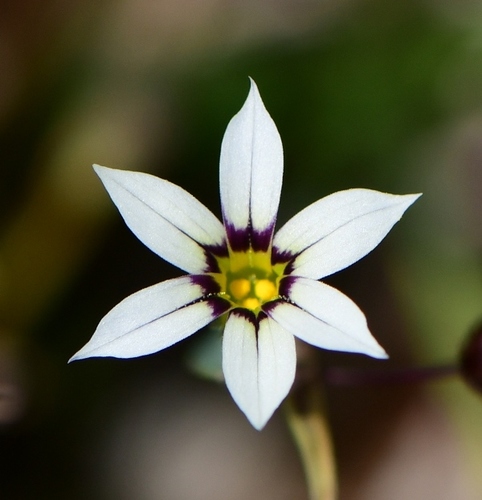
The Blue Pigroot is a small, erect annual herb growing between 5 and 40 cm tall. It features flat, winged, grass-like stems and narrow, linear leaves that wrap around the base. The standout feature is its tiny, star-shaped flowers, which are about 1 to 1.5 cm in diameter. These flowers range in color from pale blue and lavender to white, each featuring a bright yellow-orange center and distinctive dark purple-blue lines radiating outwards along the petals. After flowering, it produces small, globose, brownish seed capsules containing tiny black seeds.
Kategorie
PflanzenSeltenheit
Common
Gefahr
1/5 · Sehr gering
Snaps
Mach den ersten Snap!
Despite the common name 'blue-eyed grass' and its grassy appearance, the Blue Pigroot is actually a member of the iris family, Iridaceae.
Its seeds are housed in neat, round capsules that split open when dry, scattering tiny seeds that can easily hitchhike on lawnmowers and muddy boots.
The flowers are incredibly sensitive to the sun; they will stay closed on rainy or heavily overcast days, saving their pollen for better weather.
Its flowers open only in response to bright, direct sunlight and close rapidly on cloudy days or during the afternoon to protect delicate reproductive structures.
The plant is highly self-compatible, allowing it to produce seeds and successfully colonize new environments even when insect pollinators are scarce.
As an annual, it can rapidly grow, flower, and set seed within a single season, allowing it to exploit temporary disturbances in its habitat before competitors move in.
As a photosynthetic plant, the Blue Pigroot synthesizes its own energy from carbon dioxide, water, and sunlight.
Apis mellifera
Pollinates the flowers, collecting pollen and nectar during sunny days.
Cenchrus clandestinus
Competes directly with the Blue Pigroot for sunlight, water, and soil nutrients in domestic lawns.
Cornu aspersum
Feeds on the leaves and stems of the plant, particularly in damp garden environments.
Für dieses Objekt sind noch keine Merkmal-Badges vergeben.
Noch keine Alternativnamen vorhanden.
Sammlungen für dieses Objekt erscheinen hier, wenn weitere Themen hinzugefügt werden.
Gefahr
1/5 · Sehr gering
Noch keine besonderen Sicherheitshinweise.
Der einfachste Weg, Blue Pigroot zu bestimmen, ist die Verwendung der Naturführer-App Snappit.
5-40 cm
1 Jahre
As a photosynthetic plant, the Blue Pigroot synthesizes its own energy from carbon dioxide, water, and sunlight.
Found in open grassy fields, pastures, roadsides, disturbed areas, and domestic lawns, often favoring damp or sandy soils.
Photosynthesis
Zoome hinein, um Cluster aufzulösen und zu sehen, wo dieses Objekt fotografiert wurde.
Neueste Snaps erscheinen hier, wenn neue Beobachtungen hinzukommen.









_Bush_(28258229394).jpg&width=800)



