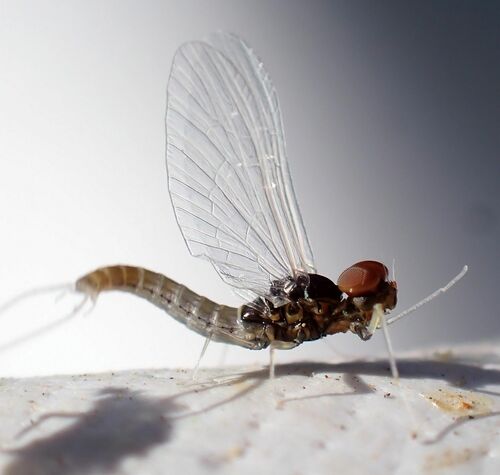


Blue-Winged Olives
baetis
Baetis, commonly known among anglers and naturalists as Blue-Winged Olives (BWOs), are a widespread and highly celebrated genus of small minnow mayflies. They are incredibly important to both aquatic ecosystems and fly-fishing culture worldwide. Spending the vast majority of their lives as aquatic nymphs hidden beneath the surface of rivers and streams, they play a crucial role in freshwater food webs. They are famous for their spectacular, synchronized mass hatches, which turn the water's surface into a frenzy of activity. Once they transition into their adult stage, they possess delicate, sail-like wings and live entirely for reproduction. Because adult mayflies lack functional mouthparts, their final life phase is beautiful but fleeting, often lasting only a day or two before they complete their life cycle.
Lebensraum: Typically found in the highly oxygenated flowing waters of freshwater streams and rivers, clinging to submerged rocks, aquatic vegetation, and woody debris.
Adult Blue-Winged Olives are characterized by their namesake slate-blue to greyish translucent wings, which stand upright like tiny sailboats when resting on the water. Their slender, distinctly segmented bodies typically range from pale olive-green to dark brownish-olive, featuring two or three long, thread-like tails (cerci) extending gracefully from the abdomen. The aquatic nymphs are small, highly streamlined, and agile, typically olive or brown to camouflage with river rocks, boasting visible gills along their abdominal segments and three distinct tail appendages.
Kategorie
InsektenSeltenheit
Common
Gefahr
1/5 · Sehr gering
Snaps
Mach den ersten Snap!
Because adult mayflies have no mouths or digestive systems, their intestines are actually filled with air to help them stay buoyant on the water's surface.
Female Baetis mayflies exhibit a unique egg-laying behavior; they often crawl completely underwater down rocks or submerged wood to deposit their eggs safely.
Fly fishers tie complex artificial lures specifically designed to mimic every single life stage of the Blue-Winged Olive, from the swimming nymph to the dying adult.
Unlike most insects, mayflies undergo a molt after they have acquired functional wings, transitioning from a dull-colored dun to a glossy, clear-winged spinner.
Entire populations emerge from the water almost simultaneously, overwhelming predators and ensuring some individuals survive to mate.
The nymphs possess highly streamlined bodies that allow them to dart quickly through fast-flowing currents and avoid aquatic predators.
They are unique among insects for having two winged adult stages: the subimago (dun) which emerges from the water, and the reproductive imago (spinner).
During their long aquatic nymph stage, they feed by grazing on organic matter, algae, and diatoms found on submerged surfaces. Adults lack mouthparts and do not eat.
Altersunterschiede: As nymphs they are active grazers, but upon emerging as adults they lose their digestive tracts and mouthparts entirely, relying solely on stored energy to mate.
Salmo trutta
Serves as a primary food source for trout species in coldwater streams.
Aquarius remigis
Preyed upon as nymphs and emerging adults by predatory aquatic insects.
Ephemerella excrucians
Competes for grazing territory and biofilm resources on submerged rocks.
Für dieses Objekt sind noch keine Merkmal-Badges vergeben.
Noch keine Alternativnamen vorhanden.
Sammlungen für dieses Objekt erscheinen hier, wenn weitere Themen hinzugefügt werden.
Gefahr
1/5 · Sehr gering
Noch keine besonderen Sicherheitshinweise.
Der einfachste Weg, Blue-Winged Olives zu bestimmen, ist die Verwendung der Naturführer-App Snappit.
1-2 cm
1-2 cm
0.00001-0.00005 kg
0-1 Jahre
During their long aquatic nymph stage, they feed by grazing on organic matter, algae, and diatoms found on submerged surfaces. Adults lack mouthparts and do not eat.
Typically found in the highly oxygenated flowing waters of freshwater streams and rivers, clinging to submerged rocks, aquatic vegetation, and woody debris.
Grazing
Zoome hinein, um Cluster aufzulösen und zu sehen, wo dieses Objekt fotografiert wurde.
Neueste Snaps erscheinen hier, wenn neue Beobachtungen hinzukommen.















