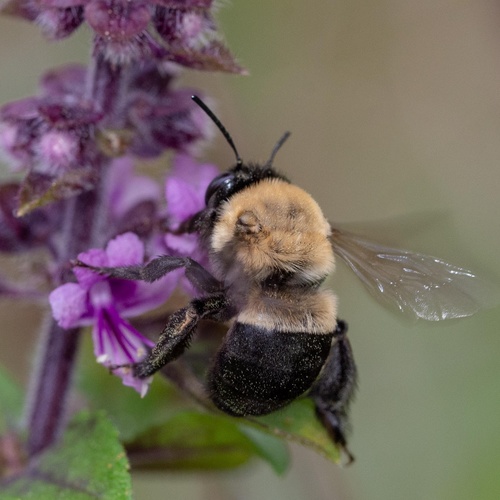


Blueberry Digger Bee
habropoda laboriosa
The Blueberry Digger Bee (Habropoda laboriosa) is a vital, native solitary bee found in the southeastern United States. Emerging in early spring, this fascinating insect has a highly specialized relationship with native blueberries. They are primary pollinators of these crops, employing a unique technique known as buzz pollination to shake pollen free from tubular flowers. This behavior makes them exceptionally efficient pollinators, often far exceeding the capabilities of introduced honey bees for these specific plants. Despite their solitary nature, females may nest in large aggregations, digging deep tunnels into sandy soil to rear their offspring. Their presence is a hallmark of a healthy spring ecosystem in sandy woodlands and agricultural fields.
Lebensraum: Typically found in open pine forests, deciduous woodland margins, and agricultural blueberry orchards with loose, sandy soils suitable for nesting.
Superficially resembling a small, sleek bumblebee, the Blueberry Digger Bee is about 1.4 to 1.7 centimeters long. It features a robust black body densely covered with pale yellow or grayish-white hairs on its thorax, while its black abdomen is marked with subtle bands of lighter hair. Females possess highly visible, dense brushes of specialized hairs called scopae on their hind legs, designed for transporting large loads of yellow blueberry pollen back to their subterranean nests.
Kategorie
InsektenSeltenheit
Common
Gefahr
1/5 · Sehr gering
Snaps
Mach den ersten Snap!
A single female blueberry digger bee can visit and pollinate up to 50,000 individual blueberry flowers during her brief adult life.
Their buzz pollination technique is so effective that it can cause a shower of pollen to fall visibly onto the bee's abdomen.
These bees are active for only a few weeks in early spring, matching the exact bloom cycle of native blueberries.
Vibrates its thoracic muscles at high frequencies while clutching a flower, forcing tightly packed pollen out of tubular anthers.
Uses its powerful mandibles and legs to dig branching nursery tunnels up to a meter deep in sandy soil.
Generates internal heat to fly and forage during cool, early-spring mornings before other pollinators are active.
Adults consume sugary flower nectar for energy and gather rich pollen to provision larval cells.
Altersunterschiede: Larvae feed on a semi-solid ball of pollen and nectar provided by their mother, while adults feed entirely on liquid nectar.
Vaccinium ashei
Serves as a primary pollinator, mutually benefiting the plant through reproduction.
Gelsemium sempervirens
Forages on early nectar, assisting with early pollination before blueberry blooms open.
Sayornis phoebe
Eaten by this opportunistic predator during foraging runs.
Für dieses Objekt sind noch keine Merkmal-Badges vergeben.
Noch keine Alternativnamen vorhanden.
Sammlungen für dieses Objekt erscheinen hier, wenn weitere Themen hinzugefügt werden.
Gefahr
1/5 · Sehr gering
Noch keine besonderen Sicherheitshinweise.
Der einfachste Weg, Blueberry Digger Bee zu bestimmen, ist die Verwendung der Naturführer-App Snappit.
1+ cm
2+ cm
0.0001+ kg
1+ Jahre
15 km/h
Adults consume sugary flower nectar for energy and gather rich pollen to provision larval cells.
Typically found in open pine forests, deciduous woodland margins, and agricultural blueberry orchards with loose, sandy soils suitable for nesting.
Zoome hinein, um Cluster aufzulösen und zu sehen, wo dieses Objekt fotografiert wurde.
Neueste Snaps erscheinen hier, wenn neue Beobachtungen hinzukommen.

South Carolina, US
Hier kann man sehen Yellow Pitcher Plant und Juvenals Wald-Dickkopffalter.
Führer anzeigen →

Alabama, US
Hier kann man sehen Horned Passalus Beetle und Amerikanischer Amberbaum.
Führer anzeigen →









_Tettigonia_viridissima_on_Avena_fatua.jpg&width=800)






