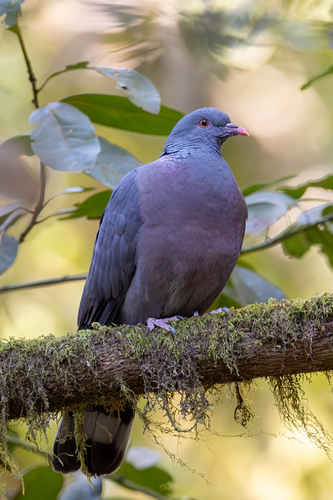


Bolle'S Pigeon
columba bollii
Bolle's Pigeon is a rare and captivating bird endemic to the laurel forests of the Canary Islands. Named after the German naturalist Carl Bolle, this species is a key ecological player in its native cloud forests, acting as a crucial seed disperser for several native tree species. It is a large, dark pigeon that moves silently through the misty canopy, making it an exciting find for dedicated birdwatchers and nature enthusiasts alike. Despite historical declines due to habitat loss and hunting, conservation efforts have helped stabilize its populations, preserving its presence in this unique, prehistoric ecosystem. Its deep, cooing calls are a signature sound of the Macaronesian forests, echoing through steep, humid ravines. Spotting this majestic bird offers a direct window into the ancient, subtropical woodlands that once covered much of the Mediterranean basin.
Lebensraum: Found in dense, humid laurel forests and steep-sided volcanic ravines of the Canary Islands.
A robust and elegant bird, Bolle's Pigeon measures about 36 to 40 centimeters in length. It is primarily characterized by its dark, slate-grey plumage, which exhibits a subtle metallic green and pink sheen on the back of its neck. Its breast features a distinct pinkish-purple wash that fades into a paler grey on the belly. Notable facial features include a bright, orange-red bill with a greyish base and striking, pale yellow eyes surrounded by a narrow red ring. In flight, a pale, light-grey band across the middle of its otherwise dark tail becomes highly visible, distinguishing it from the closely related Laurel Pigeon.
Kategorie
VögelSeltenheit
Common
Gefahr
1/5 · Sehr gering
Snaps
Mach den ersten Snap!
It builds a flimsy, loose nest of twigs on high branches, so poorly constructed that the single white egg can sometimes be seen from below.
Its survival is deeply intertwined with the ancient, mist-draped 'Laurisilva' forests, which are living fossils from the Tertiary period.
Unlike many other pigeons, Bolle's Pigeon rarely gathers in large flocks, preferring a solitary life or living in small, quiet pairs.
Possesses short, broad wings that allow it to execute rapid, highly agile maneuvers through the dense and tangled branches of the laurel forest canopy.
Plays a vital role in forest regeneration by safely digesting the flesh of large laurel fruits while passing the seeds unharmed.
Its dark, slate-grey plumage blends perfectly with the shadows and perpetual mist of the high-altitude cloud forests, rendering it nearly invisible when perched.
Feeds almost exclusively on the fleshy fruits and berries of indigenous laurel forest trees, occasionally consuming leaves, buds, and flowers.
Laurus novocanariensis
Feeds heavily on its fleshy drupes, assisting the tree's reproductive cycle through seed dispersal.
Columba junoniae
Shares the same laurel forest habitat and competes for nesting sites and fruiting trees.
Accipiter nisus granti
Acts as a key predator, occasionally hunting adults and juveniles in the forest canopy.
Für dieses Objekt sind noch keine Merkmal-Badges vergeben.
Noch keine Alternativnamen vorhanden.
Sammlungen für dieses Objekt erscheinen hier, wenn weitere Themen hinzugefügt werden.
Gefahr
1/5 · Sehr gering
Noch keine besonderen Sicherheitshinweise.
Der einfachste Weg, Bolle'S Pigeon zu bestimmen, ist die Verwendung der Naturführer-App Snappit.
36-40 cm
65-70 cm
0.35-0.45 kg
10-15 Jahre
65 km/h
Feeds almost exclusively on the fleshy fruits and berries of indigenous laurel forest trees, occasionally consuming leaves, buds, and flowers.
Found in dense, humid laurel forests and steep-sided volcanic ravines of the Canary Islands.
Zoome hinein, um Cluster aufzulösen und zu sehen, wo dieses Objekt fotografiert wurde.
Neueste Snaps erscheinen hier, wenn neue Beobachtungen hinzukommen.



%2C_Kruger_National_Park%2C_South_Africa_(14988496302).jpg&width=800)




_03.jpg&width=800)



_Sabine_Woods_TX_2018-04-21_08-32-57_(28100602238).jpg&width=800)
