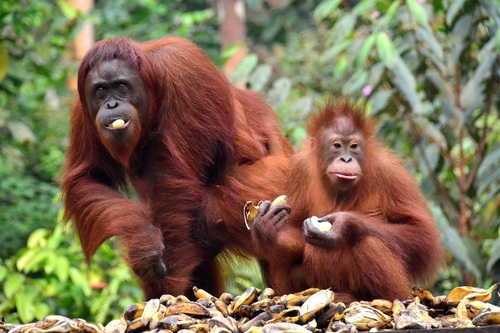


Bornean Orangutan
pongo pygmaeus
The Bornean Orangutan (Pongo pygmaeus) is one of the world's most iconic and intelligent great apes, native only to the diverse rainforests of Borneo. Known as the "person of the forest" in local Malay, these magnificent primates spend nearly all their lives high up in the forest canopy. They are famous for their slow, deliberate movements, profound cognitive abilities, and deep, expressive eyes. Unlike other great apes, they do not live in large social groups, preferring a semi-solitary lifestyle where mothers raise their single offspring for up to eight years, establishing one of the longest maternal dependency periods of any non-human mammal. These gentle giants play a vital ecological role as seed dispersers, maintaining the health of the tropical rainforest ecosystem. Their populations are under severe threat from habitat loss, making them an urgent focus for global conservation efforts.
Lebensraum: Found in low-lying tropical rainforests, peat swamp forests, and tropical valleys, primarily in the canopy layer where they build nests.
Characterized by their shaggy, reddish-orange coarse hair, Bornean Orangutans have long, powerful arms that can reach a span of over two meters, far exceeding their standing height. Adult males develop large, fleshy cheek pads, known as flanges, which frame their faces and grow larger as they mature, alongside a large throat sac used to make resonant vocalizations. They have grasping hands and feet with opposable thumbs and big toes, perfectly adapted for life in the trees. Females are significantly smaller, typically weighing about half as much as flanged males, and lack the prominent cheek flanges.
Kategorie
SäugetiereSeltenheit
Common
Gefahr
1/5 · Sehr gering
Snaps
Mach den ersten Snap!
Bornean orangutans have a much longer birth interval than any other mammal, with females giving birth only once every 7 to 9 years.
Orangutans share approximately 97% of their DNA with humans.
They build a brand new nest out of branches and leaves high in the trees to sleep in every single night.
Unlike other great apes, they are highly solitary, which helps prevent over-depletion of fruit sources in their territories.
Long, powerful arms and hook-like hands allow them to navigate the canopy and suspend their heavy bodies with minimal effort.
They utilize sticks to extract seeds from hard husks, test water depths, and construct complex overhead umbrellas or nests from leafy branches.
Mature flanged males possess a large throat sac that amplifies a booming vocalization capable of traveling over a kilometer to mark territory.
Heverly reliant on seasonal wild fruits, but they will also consume leaves, bark, flowers, insects, and occasionally bird eggs.
Altersunterschiede: Infants nurse for up to six years, gradually transitioning to solid fruits and leaves as they learn foraging skills from their mothers.
Ficus
Feeds heavily on its fruits and disperses its seeds throughout the forest floor.
Neofelis diardi
Young orangutans are occasionally preyed upon on the forest floor by this large feline predator.
Hylobates muelleri
Competes for canopy fruits and space in overlapping forest zones.
Für dieses Objekt sind noch keine Merkmal-Badges vergeben.
Noch keine Alternativnamen vorhanden.
Sammlungen für dieses Objekt erscheinen hier, wenn weitere Themen hinzugefügt werden.
Gefahr
1/5 · Sehr gering
Noch keine besonderen Sicherheitshinweise.
Der einfachste Weg, Bornean Orangutan zu bestimmen, ist die Verwendung der Naturführer-App Snappit.
100-140 cm
30-100 kg
35-45 Jahre
6 km/h
Heverly reliant on seasonal wild fruits, but they will also consume leaves, bark, flowers, insects, and occasionally bird eggs.
Found in low-lying tropical rainforests, peat swamp forests, and tropical valleys, primarily in the canopy layer where they build nests.
Foraging
Zoome hinein, um Cluster aufzulösen und zu sehen, wo dieses Objekt fotografiert wurde.
Neueste Snaps erscheinen hier, wenn neue Beobachtungen hinzukommen.

California, US
Hier kann man sehen Abessinischer Hornrabe und Chelonoidis Nigra Nigra.
Führer anzeigen →

California, US
Hier kann man sehen Afrikanischer Löwe, Komodowaran und Geparde.
Führer anzeigen →

England, UK
Hier kann man sehen Afrikanischer Löwe, Giraffen und Common Ostrich.
Führer anzeigen →













_female.jpg&width=800)
