

Botrychium Lunaria
botrychium lunaria
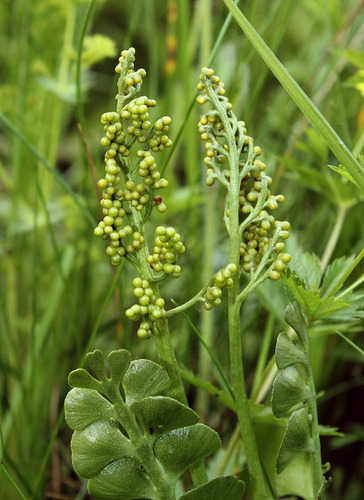
The Common Moonwort (Botrychium lunaria) is a fascinating, primitive fern with a rich history steeped in medieval folklore. Unlike typical modern ferns that display large, feathery fronds, this small and unassuming species grows a single, pale-green leaf divided into crescent-shaped segments that resemble half-moons. Alongside this sterile leaf, it produces a separate, upright spike carrying golden-brown clusters of spore cases that mimic tiny bunches of grapes. Because of its unusual appearance and secretive growth habits, ancient herbalists believed the plant had magical properties, including the power to open locks and loose the shoes from horses' hooves.
Lebensraum: Typically found in dry, nutrient-poor grasslands, sand dunes, heaths, and open montane meadows, often in partnership with specialized soil fungi.
This diminutive plant typically stands between 5 and 20 centimeters tall. It is characterized by a single fleshy, yellowish-green stem that splits into two parts: a sterile, leaf-like blade and a fertile, spore-bearing spike. The sterile blade features 4 to 9 pairs of distinctive, fan-shaped or crescent-shaped leaflets that slightly overlap. The fertile portion is taller, branched, and holds globose sporangia that transition from green to a rich, warm golden-brown as they mature during the summer months.
Kategorie
PflanzenSeltenheit
Common
Gefahr
1/5 · Sehr gering
Snaps
Mach den ersten Snap!
In historical folklore, alchemists believed that moonwort could convert quicksilver into silver, and that walking over it would cause horseshoes to fall off.
Its scientific name Botrychium is derived from the ancient Greek word for a bunch of grapes, referencing the appearance of its spore-bearing spikes.
The subterranean gametophyte stage of this fern is entirely colorless and blind, living completely underground in total darkness for years before ever producing a green leaf.
It maintains an obligate symbiotic relationship with underground fungi, relying on them for nutrients and water throughout its entire lifecycle.
It can survive underground for multiple consecutive years without producing any above-ground leaves, sustained entirely by its fungal partners.
Its specialized fertile spike acts as a highly efficient wind-dispersal mechanism, elevating its spores above low-lying grasses.
As a photosynthetic plant, it generates energy from sunlight, carbon dioxide, and water, heavily assisted by mycorrhizal fungi in the soil.
Glomus intraradices
Forms an obligate symbiotic relationship with arbuscular mycorrhizal fungi to obtain essential nutrients.
Oryctolagus cuniculus
Occasionally grazed upon by wild rabbits in open meadow environments.
Für dieses Objekt sind noch keine Merkmal-Badges vergeben.
Noch keine Alternativnamen vorhanden.
Sammlungen für dieses Objekt erscheinen hier, wenn weitere Themen hinzugefügt werden.
Gefahr
1/5 · Sehr gering
Noch keine besonderen Sicherheitshinweise.
Der einfachste Weg, Botrychium Lunaria zu bestimmen, ist die Verwendung der Naturführer-App Snappit.
5-25 cm
0.001-0.01 kg
5-15 Jahre
As a photosynthetic plant, it generates energy from sunlight, carbon dioxide, and water, heavily assisted by mycorrhizal fungi in the soil.
Typically found in dry, nutrient-poor grasslands, sand dunes, heaths, and open montane meadows, often in partnership with specialized soil fungi.
Photosynthesis1234567890fdfdfdfdsaasdaffdfsdafsadfasfdasdafsdafsdfasfdfsdfasfdfasdafsdafsadfa
Zoome hinein, um Cluster aufzulösen und zu sehen, wo dieses Objekt fotografiert wurde.
Neueste Snaps erscheinen hier, wenn neue Beobachtungen hinzukommen.













.jpg&width=800)





