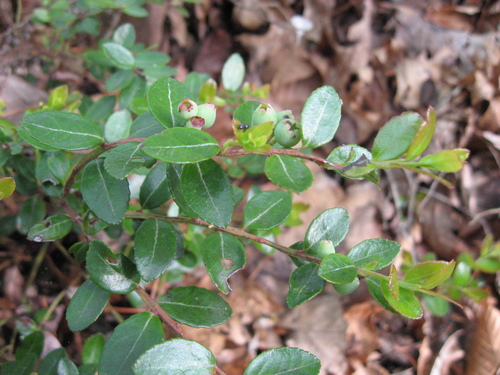


Box Huckleberry
gaylussacia brachycera
The Box Huckleberry (Gaylussacia brachycera) is an extraordinary, low-growing evergreen shrub that holds a legendary status in the botanical world. Native to the Appalachian region of the eastern United States, this ancient plant forms vast, carpet-like colonies that spread incredibly slowly via underground rhizomes. Because it rarely produces viable seeds, these single-clone colonies are genetic individuals that have survived undisturbed for thousands of years, with one famous colony in Pennsylvania estimated to be over 13,000 years old. This makes it one of the oldest living organisms on the planet, a silent witness to the end of the last Ice Age. Gardeners and nature lovers cherish the Box Huckleberry not only for its incredible history but also for its delicate bell-shaped spring flowers, sweet blue berries, and glossy foliage that turns a beautiful deep bronze in winter. Encountering this botanical relic in the wild is a rare and humbling experience, connecting us directly to prehistoric North America.
Lebensraum: Typically found in dry, acidic soils of wooded slopes, pine barrens, and oak-heath forests.
This low, creeping shrub typically grows to a height of just 15 to 40 centimeters, forming dense, glossy green groundcover. Its oval leaves are leathery, finely toothed, and strongly resemble those of boxwood, measuring about 1 to 2.5 centimeters long. In late spring, the plant bears small, delicate, urn-shaped flowers that range in color from white to light pink. These blooms give way to small, globose, light blue to black berries in mid-to-late summer. In the colder winter months, the otherwise evergreen foliage undergoes a dramatic transformation, turning a rich reddish-bronze color.
Kategorie
PflanzenSeltenheit
Common
Gefahr
1/5 · Sehr gering
Snaps
Mach den ersten Snap!
Because it expands outward at a rate of only about 15 centimeters per year, a single colony measuring over a mile wide is estimated to be approximately 13,000 years old.
It was first discovered by botanist André Michaux in 1796, but was lost to science for decades before being rediscovered in Pennsylvania in the mid-19th century.
The box huckleberry is self-sterile, meaning individual colonies cannot self-pollinate; since most colonies are a single genetic clone, they rarely produce viable seeds.
Spreads almost entirely through underground rhizomes to create massive, single-clone colonies that can survive for thousands of years.
Thrives in nutrient-poor, highly acidic soils by forming symbiotic relationships with mycorrhizal fungi to absorb scarce nutrients.
Alters its leaf pigmentation to a reddish-bronze shade during winter, helping protect its evergreen tissues from cold damage.
As an autotrophic plant, the box huckleberry produces its own organic nutrients through photosynthesis using sunlight, water, and carbon dioxide.
Bombus impatiens
Pollinates the bell-shaped flowers of the box huckleberry in spring.
Ursus americanus
Consumes the sweet blue berries in summer, assisting in occasional seed dispersal.
Für dieses Objekt sind noch keine Merkmal-Badges vergeben.
Noch keine Alternativnamen vorhanden.
Sammlungen für dieses Objekt erscheinen hier, wenn weitere Themen hinzugefügt werden.
Gefahr
1/5 · Sehr gering
Noch keine besonderen Sicherheitshinweise.
Der einfachste Weg, Box Huckleberry zu bestimmen, ist die Verwendung der Naturführer-App Snappit.
15+ cm
1000+ Jahre
As an autotrophic plant, the box huckleberry produces its own organic nutrients through photosynthesis using sunlight, water, and carbon dioxide.
Typically found in dry, acidic soils of wooded slopes, pine barrens, and oak-heath forests.
Zoome hinein, um Cluster aufzulösen und zu sehen, wo dieses Objekt fotografiert wurde.
Neueste Snaps erscheinen hier, wenn neue Beobachtungen hinzukommen.