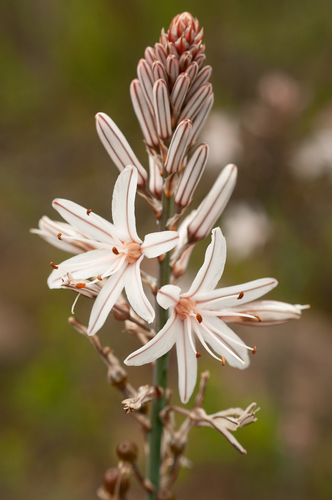


Branched Asphodel
asphodelus ramosus
The Branched Asphodel (Asphodelus ramosus) is a striking perennial herb native to the Mediterranean region, famed for its tall, candelabra-like flower spikes that dominate dry landscapes in spring. Often considered a symbol of resilience, it thrives in challenging, arid conditions where many other plants struggle. Its impressive stature and abundant white flowers make it a highly recognizable and beautiful component of Mediterranean garrigue, maquis, and grasslands. This species holds a rich cultural history, appearing in ancient Greek mythology and folklore, often associated with the underworld and eternal fields.
Lebensraum: Found in dry, stony grasslands, rocky slopes, open woodlands, abandoned fields, and olive groves across the Mediterranean Basin.
Branched Asphodel features a robust, unbranched basal stem that can reach up to 150 cm tall, branching into an impressive inflorescence. Its numerous star-shaped flowers are typically pure white with a distinct pinkish-brown or green central stripe on each petal. The basal leaves are long, narrow, and strap-like, forming a dense rosette at the base, often with a slightly glaucous, bluish-green hue. After flowering, the plant produces distinctive spherical, woody capsules containing its seeds.
Kategorie
PflanzenSeltenheit
Common
Gefahr
1/5 · Sehr gering
Snaps
Mach den ersten Snap!
Despite its beauty, the plant's tubers are toxic to livestock if consumed in large quantities, causing digestive issues, though some animals may browse it.
In ancient Greece, asphodel flowers were planted near graves and were believed to grow in the Asphodel Meadows, the resting place for ordinary souls in the underworld.
Its robust woody fruit capsules are distinctive and can persist on the plant for a long time after the flowers have faded.
The plant's scientific name 'Asphodelus' is derived from the Greek 'asphodelos', a plant whose roots were supposedly eaten by the poor.
This plant possesses fleshy, tuberous roots that store water and nutrients, enabling it to survive prolonged dry periods and flourish in arid Mediterranean climates.
Its numerous white, nectar-rich flowers are designed to attract a wide array of insect pollinators, ensuring effective reproduction even in challenging environments.
Asphodelus ramosus contributes to soil health and nutrient cycling in often nutrient-poor Mediterranean soils, helping to support the broader ecosystem.
As an autotrophic plant, Branched Asphodel produces its own food through photosynthesis, converting sunlight, carbon dioxide, and water into sugars. It absorbs essential minerals and nutrients from the soil via its root system.
Apis mellifera
Pollination
Ovis aries
Grazing herbivore
Glomus intraradices
Soil nutrient absorption
Avena fatua
Competition for resources
Für dieses Objekt sind noch keine Merkmal-Badges vergeben.
Noch keine Alternativnamen vorhanden.
Sammlungen für dieses Objekt erscheinen hier, wenn weitere Themen hinzugefügt werden.
Gefahr
1/5 · Sehr gering
Noch keine besonderen Sicherheitshinweise.
Der einfachste Weg, Branched Asphodel zu bestimmen, ist die Verwendung der Naturführer-App Snappit.
50-150 cm
0.1-0.5 kg
3-10 Jahre
As an autotrophic plant, Branched Asphodel produces its own food through photosynthesis, converting sunlight, carbon dioxide, and water into sugars. It absorbs essential minerals and nutrients from the soil via its root system.
Found in dry, stony grasslands, rocky slopes, open woodlands, abandoned fields, and olive groves across the Mediterranean Basin.
Absorption
Zoome hinein, um Cluster aufzulösen und zu sehen, wo dieses Objekt fotografiert wurde.
Neueste Snaps erscheinen hier, wenn neue Beobachtungen hinzukommen.



