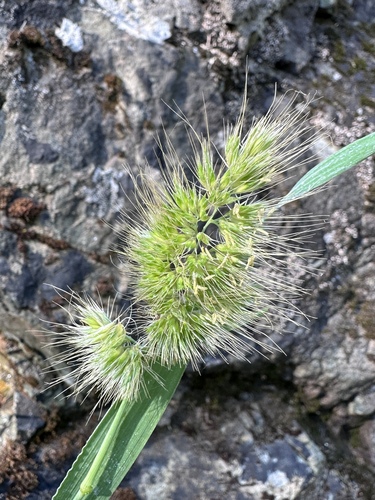


Bristly Dogtail Grass
cynosurus echinatus
Bristly dogtail grass (Cynosurus echinatus), also known as hedgehog dogtail, is a distinctive annual grass native to Southern Europe and the Mediterranean, but it has naturalized across many other temperate regions globally. This hardy grass is easily recognized by its compact, bristly seed heads that bear a striking resemblance to a miniature hedgehog or a stiff dog's tail. While often classified as an invasive weed in agricultural settings and native ecosystems, it remains a fascinating subject for botanical observers due to its highly specialized reproductive anatomy. Thriving in dry, sunny, and disturbed soils, this species is a fast-growing pioneer plant. It successfully colonizes bare ground ahead of other perennial species, utilizing its rapid life cycle to secure space and resources. Though it lacks nutritional value for livestock once matured and can actually cause physical irritation to grazing animals, its unique structure makes it an intriguing find during dry-season nature walks.
Lebensraum: Commonly found in disturbed areas, dry pastures, grassy hillsides, and along roadsides under full sun.
Bristly dogtail grass typically grows between 10 to 80 centimeters in height, featuring upright, slender green stems and flat, slightly rough-textured leaves. Its most defining characteristic is the dense, one-sided bristly seed head (panicle) measuring 1 to 5 centimeters in length. This bristly clump is pale green to purplish-brown when mature and features comb-like sterile spikelets mixed with fertile ones. The long, stiff bristles (awns) on these spikelets can reach up to 2.5 centimeters, giving the entire seed head a remarkably prickly, bristly silhouette.
Kategorie
PflanzenSeltenheit
Common
Gefahr
1/5 · Sehr gering
Snaps
Mach den ersten Snap!
Once the bristly seed head dries out, the awns become incredibly stiff and sharp, capable of causing painful irritation in the mouths and ears of grazing livestock.
The scientific name 'echinatus' originates from the Greek word for hedgehog, directly referencing the prickly, spiky appearance of the plant's mature seed head.
Unlike many other grasses, its seed head is noticeably one-sided, with all the dense spikelets oriented towards a single direction.
The long, rigid bristles (awns) covering its seed heads act like natural Velcro, easily latching onto animal fur or human clothing to hitchhike to new growth sites.
As an annual species, it completes its life cycle quickly, allowing it to germinate, mature, and distribute seeds in disturbed soils before perennial competitors can establish.
Equipped with a fibrous root network and specialized leaf coatings, it conserves water effectively during the intense, dry summer heat of Mediterranean-type climates.
As a photosynthetic plant, it synthesizes its own organic nutrients from sunlight, water, carbon dioxide, and key soil minerals.
Oryctolagus cuniculus
Feeds on the tender green shoots of the grass in the spring, though it avoids the spiky mature seed heads.
Bos taurus
Occasionally grazes on the young vegetative growth, but can experience mouth and throat injuries from the sharp awns of mature plants.
Festuca pratensis
Competes directly with this annual grass for soil moisture, nutrients, and sunlight in open fields.
Für dieses Objekt sind noch keine Merkmal-Badges vergeben.
Noch keine Alternativnamen vorhanden.
Sammlungen für dieses Objekt erscheinen hier, wenn weitere Themen hinzugefügt werden.
Gefahr
1/5 · Sehr gering
Noch keine besonderen Sicherheitshinweise.
Der einfachste Weg, Bristly Dogtail Grass zu bestimmen, ist die Verwendung der Naturführer-App Snappit.
10-80 cm
1 Jahre
As a photosynthetic plant, it synthesizes its own organic nutrients from sunlight, water, carbon dioxide, and key soil minerals.
Commonly found in disturbed areas, dry pastures, grassy hillsides, and along roadsides under full sun.
Zoome hinein, um Cluster aufzulösen und zu sehen, wo dieses Objekt fotografiert wurde.
Neueste Snaps erscheinen hier, wenn neue Beobachtungen hinzukommen.











.jpg&width=800)




.jpg&width=800)
