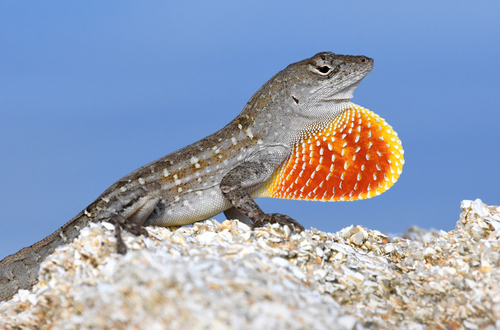
Brown Basilisk
basiliscus vittatus
The Brown Basilisk is a lizard that can run on water! It has a cool crest on its head that makes it look like a little dinosaur!
Lebensraum: Tropical rainforests near rivers and streams.
The Brown Basilisk has a slender body with olive to brown scales, often marked with darker crossbands and yellowish stripes along its flanks. Males display distinct crests on their head, back, and tail, making them look like miniature dinosaurs.
Kategorie
ReptilienSeltenheit
Common
Gefahr
0/5 · Keine bekannte Gefahr
Snaps
Mach den ersten Snap!
Baby basilisks can run on water almost immediately after hatching!
Its big hind feet have fringes that fan out, helping it run on water!
Males have three crests: one on the head, one on the back, and one on the tail!
They lay their eggs in burrows, sometimes digging tunnels up to 30 cm deep!
Brown Basilisks can sprint across water because of specialized feet and a fast running style that helps them escape predators.
Brown Basilisks can dive and stay submerged for long periods because they can hold their breath, which helps them hide from threats.
Brown Basilisks can subtly change their skin color to blend in because of specialized cells, helping them hide from predators and prey.
They munch on insects and spiders, but also enjoy a juicy fruit or flower now and then!
Boa constrictor
A large snake that preys on lizards.
Leptophis mexicanus
A slender snake that eats lizards.
Gryllus assimilis
A common insect often caught by basilisks.

Schistocerca nitens
A large grasshopper eaten by these lizards.
Einzelgänger leben den größten Teil ihres Lebens allein und interagieren mit Artgenossen nur zur Paarung oder zur Aufzucht der Jungen.
Baumbewohnende Tiere leben hauptsächlich in Bäumen und nutzen diese als Unterschlupf, Nahrungsquelle und zum Schutz vor Raubtieren.
Farbenfroh beschreibt Organismen oder Objekte, die eine große Vielfalt an leuchtenden und deutlich erkennbaren Farben aufweisen.
Tagaktive Tiere sind hauptsächlich bei Tageslicht aktiv und ruhen oder schlafen in der Regel nachts.
Gefahr
0/5 · Keine bekannte Gefahr
Noch keine besonderen Sicherheitshinweise.
50-80 cm
0.2-0.6 kg
5-7 Jahre
11 km/h
They munch on insects and spiders, but also enjoy a juicy fruit or flower now and then!
3 km/h
Tropical rainforests near rivers and streams.
Ambush
Zoome hinein, um Cluster aufzulösen und zu sehen, wo dieses Objekt fotografiert wurde.
Neueste Snaps erscheinen hier, wenn neue Beobachtungen hinzukommen.