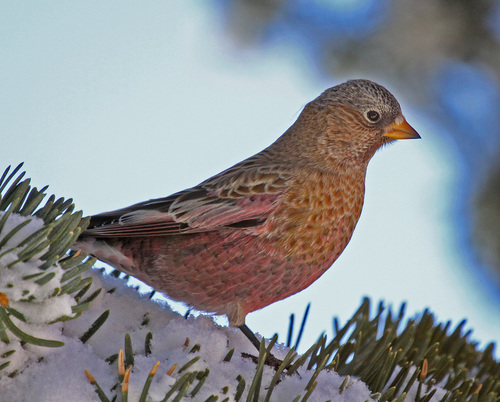


Brown-Capped Rosy-Finch
leucosticte australis
The Brown-Capped Rosy-Finch (Leucosticte australis) is a hardy passerine bird known for its remarkable adaptation to extreme alpine environments. This species is native to the high peaks of the southern Rocky Mountains, where it thrives in harsh, cold conditions year-round, often foraging around permanent snowfields and glaciers. These social birds are a delight to spot for their striking plumage and their ability to withstand altitudes where few other avian species venture. They are truly emblematic of North American high-altitude wildlife, representing resilience and specialized ecological niches.
Lebensraum: Typically found in rugged, barren alpine tundra and subalpine zones, often foraging on rocky slopes, cliffs, and around permanent snowfields or glaciers above the tree line.
This medium-sized finch features a distinctive brown crown and nape that contrast with a gray face and throat. Its body plumage is primarily brownish, with a beautiful rosy-pink wash on the belly, flanks, and wing-linings, which becomes more vibrant in breeding males. The back is streaked with black, and it has a relatively short, conical bill suited for seed eating. Its tail is moderately long and slightly forked, and it sports dark legs and feet.
Kategorie
VögelSeltenheit
Common
Gefahr
1/5 · Sehr gering
Snaps
Mach den ersten Snap!
Brown-Capped Rosy-Finches are part of a 'superspecies' complex with the Gray-Crowned and Black Rosy-Finches, all adapted to similar cold, high-altitude environments.
The Brown-Capped Rosy-Finch is considered one of North America's highest-dwelling birds, nesting and foraging at elevations exceeding 3,700 meters (12,000 feet) and sometimes much higher.
These birds are incredibly social outside of the breeding season, forming large flocks of hundreds or even thousands of individuals that move together across the winter landscape.
Unlike most migratory birds, rosy-finches often move to lower elevations during winter rather than south, making them 'altitudinal migrants'.
Brown-Capped Rosy-Finches possess physiological adaptations, including dense plumage and a high metabolic rate, allowing them to survive and forage in temperatures well below freezing, even during harsh alpine winters.
These finches are adept at foraging for insects that become trapped or frozen on snowfields and glaciers, providing a unique food source in an otherwise barren environment, especially during summer months.
They are among the highest-nesting birds in North America, constructing their nests in crevices and under ledges on cliffs in exposed alpine terrain, far above the timberline.
The Brown-Capped Rosy-Finch primarily consumes seeds and insects, with its diet varying seasonally based on availability. Seeds form a significant part of their winter diet, while insects are crucial during the breeding season.
Falco mexicanus
A primary predator that preys on finches in high-alpine environments.
Geum rossii
Consumes various seeds from alpine plants, acting as a seed disperser.
various Diptera species
Forages on insects, including flies, that are found in alpine habitats.
Leucosticte tephrocotis
Competes for food resources and nesting sites, especially when ranges overlap.
Für dieses Objekt sind noch keine Merkmal-Badges vergeben.
Noch keine Alternativnamen vorhanden.
Sammlungen für dieses Objekt erscheinen hier, wenn weitere Themen hinzugefügt werden.
Gefahr
1/5 · Sehr gering
Noch keine besonderen Sicherheitshinweise.
Der einfachste Weg, Brown-Capped Rosy-Finch zu bestimmen, ist die Verwendung der Naturführer-App Snappit.
14-16 cm
28-30 cm
0.02-0.03 kg
3-5 Jahre
55 km/h
The Brown-Capped Rosy-Finch primarily consumes seeds and insects, with its diet varying seasonally based on availability. Seeds form a significant part of their winter diet, while insects are crucial during the breeding season.
Typically found in rugged, barren alpine tundra and subalpine zones, often foraging on rocky slopes, cliffs, and around permanent snowfields or glaciers above the tree line.
Zoome hinein, um Cluster aufzulösen und zu sehen, wo dieses Objekt fotografiert wurde.
Neueste Snaps erscheinen hier, wenn neue Beobachtungen hinzukommen.




.jpg&width=800)



.jpg&width=800)



_(19730267073).jpg&width=800)


