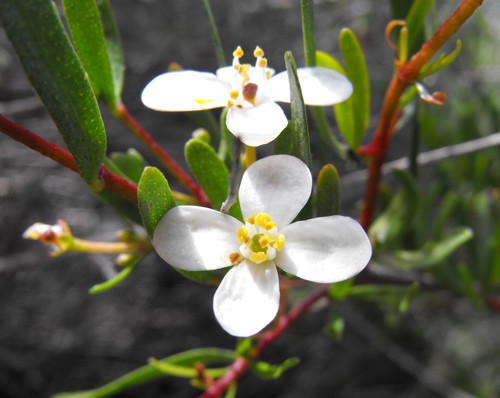


Bushrue
cneoridium dumosum
Bushrue (Cneoridium dumosum) is a captivating, resilient evergreen shrub native to the chaparral and coastal sage scrub ecosystems of Southern California and Baja California. As a member of the citrus family (Rutaceae), this unassuming plant hides a delightful secret: when crushed, its narrow, leathery leaves release a potent, distinctively citrusy aroma. This adaptation not only delights hikers but also serves to deter thirsty herbivores and reduce water loss in its arid habitat. Blooming from late fall to early spring, the Bushrue graces the often-dry landscape with clusters of delicate, star-shaped white flowers. These blossoms eventually give way to small, reddish-brown berry-like capsules. Its tough, intricately branched structure allows it to thrive in nutrient-poor soils and withstand the punishing dry seasons of the Pacific coast, making it a true survivor of the rugged chaparral environment.
Lebensraum: Found almost exclusively in dry, rocky soils of chaparral and coastal sage scrub ecosystems along the coast and foothills of Southern California and Baja California.
The Bushrue is a densely branched evergreen shrub typically reaching 50 to 150 centimeters in height. Its stems are covered in rough, grayish-brown bark that twists through its complex branch structure. The leaves are simple, linear to slightly spatulate, growing in opposite pairs or small clusters, and have a distinctive gray-green hue with small, translucent oil glands visible when held up to the light. From November to March, it produces small, four-petaled white flowers, each about a centimeter across, which stand out sharply against the dark foliage. Following pollination, it yields small, spherical fruits that transition from green to a deep reddish-brown, forming dry capsules upon maturity.
Kategorie
PflanzenSeltenheit
Common
Gefahr
1/5 · Sehr gering
Snaps
Mach den ersten Snap!
Bushrue is the only species in the genus Cneoridium, making it a unique evolutionary offshoot within the citrus family.
It is one of the few chaparral shrubs that actively puts out new growth and blooms in the dead of winter, taking advantage of seasonal rains.
The strong scent of its crushed leaves is often compared to a mix of bitter orange, pine, and pungent herbs.
When viewed against a bright light, the tiny, translucent dots on Bushrue leaves are actually oil glands packed with volatile compounds.
Produces pungent essential oils in its leaves that give off a citrus scent, deterring herbivory and reducing transpiration rates in the intense sun.
Possesses a deep, robust root system and small, leathery leaves that allow it to survive extended periods of severe drought common in its native chaparral habitat.
Uniquely timed to flower during the cooler, wetter winter and early spring months, maximizing its chances of successful pollination and seed development before the harsh summer dry season begins.
As a photosynthetic plant, Bushrue produces its own food by converting sunlight, water, and atmospheric carbon dioxide into essential carbohydrates.
Papilio zelicaon
Caterpillars of this swallowtail species occasionally use Bushrue and other members of the citrus family as a host plant.
Bombus vosnesenskii
Native bees visit the winter-blooming flowers of the Bushrue to collect nectar and pollen, aiding in the plant's reproduction.
Odocoileus hemionus
Though deterred by its strong aromatic oils, desperate deer may occasionally browse on young shoots during extreme drought.
Für dieses Objekt sind noch keine Merkmal-Badges vergeben.
Noch keine Alternativnamen vorhanden.
Sammlungen für dieses Objekt erscheinen hier, wenn weitere Themen hinzugefügt werden.
Gefahr
1/5 · Sehr gering
Noch keine besonderen Sicherheitshinweise.
Der einfachste Weg, Bushrue zu bestimmen, ist die Verwendung der Naturführer-App Snappit.
50-150 cm
10-50 Jahre
As a photosynthetic plant, Bushrue produces its own food by converting sunlight, water, and atmospheric carbon dioxide into essential carbohydrates.
Found almost exclusively in dry, rocky soils of chaparral and coastal sage scrub ecosystems along the coast and foothills of Southern California and Baja California.
Zoome hinein, um Cluster aufzulösen und zu sehen, wo dieses Objekt fotografiert wurde.
Neueste Snaps erscheinen hier, wenn neue Beobachtungen hinzukommen.





.jpg&width=800)








_Calycanthus_floridus_-_Les_Martels%2C_Giroussens_Tarn.jpg&width=800)

