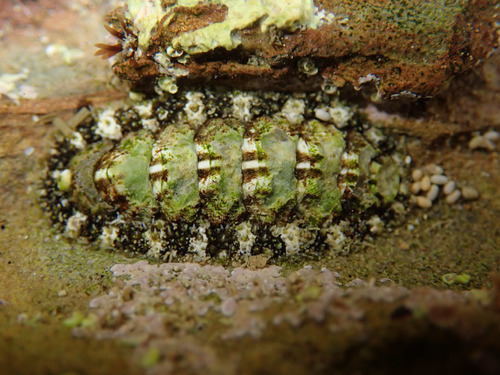


California Spiny Chiton
nuttallina californica
The California Spiny Chiton (Nuttallina californica) is a resilient marine mollusk native to the rugged intertidal zones of the North American Pacific coast. Easily recognized by its oval, eight-plated shell surrounded by a bristly, spine-covered border called a girdle, this hardy creature is perfectly adapted to survive the punishing force of crashing waves. It is highly famous for its homing behavior; individuals erode form-fitting depressions, known as "home scars," into rocky sandstone reefs over their lifetimes. These secure pits prevent them from drying out during low tide and shelter them from predators. As crucial grazers of the intertidal ecosystem, they feed on algae and play a vital role in maintaining the balance of local marine flora.
Lebensraum: Found in the high to mid-intertidal rocky shores, often nestled in self-eroded pits on wave-swept sandstone or shale reefs.
This species is a medium-sized chiton typically measuring between 2.5 and 5 centimeters in length, featuring an elongated oval body. Its eight overlapping shell plates are usually heavily eroded, pitted, or encrusted with algae, displaying dull shades of brown, dark green, or gray. The most distinguishing visual marker is its prominent, fleshy girdle, which is thickly carpeted with stiff, dark, spine-like bristles. The underside of the animal consists of a broad, muscular foot used for suctioning onto rocks, which is pale cream to light orange-yellow in color.
Kategorie
InvertebrateSeltenheit
Common
Gefahr
1/5 · Sehr gering
Snaps
Mach den ersten Snap!
By boring pits into coastal rocks, these chitons act as ecosystem engineers, creating microhabitats that other small intertidal creatures use for shelter.
If accidentally dislodged by strong waves or a predator, the California Spiny Chiton can roll into a tight ball, much like a land-dwelling pillbug, to protect its soft underparts.
The teeth on a chiton's radula are capped with magnetite, making them hard enough to leave visible scrape marks on sandstone rocks.
Slowly grinds away rocky substrate using its hard teeth and shell valves to carve a form-fitting pit that acts as a secure home.
Exhibits strong navigation skills, leaving its rock scar at high tide to forage for food and returning to the exact same position before the tide recedes.
Utilizes teeth capped with magnetite, a highly magnetic iron mineral, allowing it to scrape tough algae off hard rock without wearing down its radula.
Primarily grazes on microalgae, sporelings, and various small seaweeds growing on rocky surfaces in the intertidal zone.
Altersunterschiede: Juveniles consume almost exclusively microscopic biofilms and diatoms, while mature adults graze on larger red and green macroalgae.
Haematopus bachmani
Frequently preyed upon by this coastal bird, which uses its chisel-like beak to pry the chiton from its rocky depression.
Pisaster ochraceus
Preyed upon by this sea star during high tide when the chiton is submerged.
Ulva lactuca
A primary green macroalgae species consumed by grazing chitons.
Für dieses Objekt sind noch keine Merkmal-Badges vergeben.
Noch keine Alternativnamen vorhanden.
Sammlungen für dieses Objekt erscheinen hier, wenn weitere Themen hinzugefügt werden.
Gefahr
1/5 · Sehr gering
Noch keine besonderen Sicherheitshinweise.
Der einfachste Weg, California Spiny Chiton zu bestimmen, ist die Verwendung der Naturführer-App Snappit.
2-5 cm
0.005-0.02 kg
5-20 Jahre
Primarily grazes on microalgae, sporelings, and various small seaweeds growing on rocky surfaces in the intertidal zone.
Found in the high to mid-intertidal rocky shores, often nestled in self-eroded pits on wave-swept sandstone or shale reefs.
Grazing
1-3 Tage
Zoome hinein, um Cluster aufzulösen und zu sehen, wo dieses Objekt fotografiert wurde.
Neueste Snaps erscheinen hier, wenn neue Beobachtungen hinzukommen.













.jpg&width=800)


