

Caltha-Leaf Phacelia
phacelia calthifolia
The Caltha-Leaf Phacelia (Phacelia calthifolia) is a striking annual wildflower native to the arid desert regions of the southwestern United States, most famously coloring the gravelly washes and slopes of Death Valley and the Mojave Desert. Rising up in the wake of winter rains, this resilient plant plays a vital role in the brief spring ecology of the desert, providing abundant nectar for specialized native pollinators. It is particularly known for its intense violet-purple blooms and sticky, rounded leaves that heavily resemble marsh marigolds. However, despite its beauty, travelers must admire it from a distance, as the plant can cause severe skin irritation similar to poison oak.
Lebensraum: Found in dry, sandy or gravelly washes, canyon bottoms, and alluvial flats within Mojave Desert ecosystems below 1,500 meters.
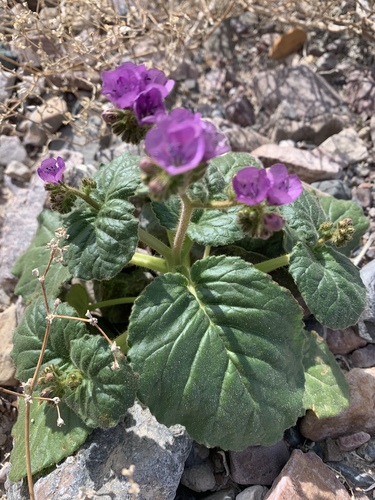
This erect, sticky-haired annual typically reaches heights of 10 to 30 centimeters. It features thick, rounded to heart-shaped dark green leaves with scalloped margins that grow along the reddish, glandular stems. The flowers are arranged in characteristic curled, scorpion-tail-like clusters (scorpioid cymes) that uncoil as they bloom. Each bell-shaped blossom is a deep, vivid royal purple to indigo, highlighted by bright, golden-yellow stamens protruding conspicuously from the center.
Kategorie
PflanzenSeltenheit
Common
Gefahr
1/5 · Sehr gering
Snaps
Mach den ersten Snap!
During rare 'superbloom' events in Death Valley National Park, this species covers miles of dry, rocky ground in a sea of vibrant indigo.
Like poison oak, contact with this plant can cause a severe blistering skin rash on humans, earning it the colloquial nickname 'scorpion weed'.
The plant's scientific species name, calthifolia, literally translates to 'Caltha-leaved' due to the uncanny resemblance of its foliage to marsh marigolds.
The plant is covered in glandular hairs that exude sticky, oily secretions containing heptadecylcatechol, which causes a severe, itchy rash on herbivores and humans.
Its seeds possess a dormant protective coating that only breaks down after significant winter rainfall, ensuring the plant only grows when water is available.
Its flowering stalks slowly uncurl over several weeks, presenting a continuous sequence of fresh blooms to maximize pollination chances over a longer period.
As a photosynthetic autotroph, this plant generates its own organic nutrients from sunlight, carbon dioxide, and soil minerals.
Centris pallida
Collects nectar and pollen from the flowers, acting as a primary pollinator in arid desert environments.
Gopherus agassizii
Occasionally grazes on the lush foliage and flowers during the wet spring seasons.
Für dieses Objekt sind noch keine Merkmal-Badges vergeben.
Noch keine Alternativnamen vorhanden.
Sammlungen für dieses Objekt erscheinen hier, wenn weitere Themen hinzugefügt werden.
Gefahr
1/5 · Sehr gering
Noch keine besonderen Sicherheitshinweise.
Der einfachste Weg, Caltha-Leaf Phacelia zu bestimmen, ist die Verwendung der Naturführer-App Snappit.
As a photosynthetic autotroph, this plant generates its own organic nutrients from sunlight, carbon dioxide, and soil minerals.
Found in dry, sandy or gravelly washes, canyon bottoms, and alluvial flats within Mojave Desert ecosystems below 1,500 meters.
Zoome hinein, um Cluster aufzulösen und zu sehen, wo dieses Objekt fotografiert wurde.
Neueste Snaps erscheinen hier, wenn neue Beobachtungen hinzukommen.













