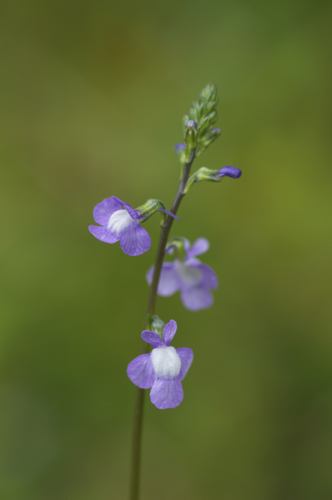


Canada Toadflax
linaria canadensis
Canada Toadflax is a slender, delicate annual or biennial wildflower native to North America. Known for its small, pale blue to violet flowers, this charming plant is a resilient colonizer of sandy, nutrient-poor soils. It thrives in open, disturbed environments, such as roadsides, fields, and clearing edges, where it often forms sparse, misty-blue sweeps of color during the spring and summer. Despite its fragile appearance, Canada Toadflax is incredibly tough, adapting to harsh conditions and acting as an early pioneer species in recovering ecosystems. It serves as an important nectar source for a variety of small pollinators, including native bees and butterflies, making it a valuable contributor to local biodiversity.
Lebensraum: Found in open, sunny areas with dry, sandy or gravelly soils, such as coastal dunes, roadsides, disturbed fields, and pinelands.
This erect plant typically grows between 10 to 80 centimeters tall, featuring simple or branched, smooth green stems. At the base, it produces a rosette of small, oblong leaves, while the leaves along the upper stem are narrow, linear, and alternate. The small, two-lipped flowers, measuring about 8 to 15 millimeters long, are a light blue-violet to pale lavender with a distinct white palate on the lower lip. A key identifier is the slender, curved spur extending from the back of the flower, which holds its nectar.
Kategorie
PflanzenSeltenheit
Common
Gefahr
1/5 · Sehr gering
Snaps
Mach den ersten Snap!
Despite its delicate and fragile appearance, Canada Toadflax can easily push through hard, compacted gravel along highway shoulders.
Its flowers feature a tiny 'trapdoor' palate that requires a heavier insect, like a bumblebee, to force open to reach the nectar reward.
The plant produces two entirely different types of flowers on the same individual: normal showy ones and hidden, self-pollinating ones.
Develops a deep, slender taproot that allows it to access moisture locked deep in sandy or rocky soils where other plants would wither.
Produces inconspicuous, self-pollinating closed flowers near the base of the plant during unfavorable conditions, ensuring seed production without relying on pollinators.
Quickly establishes itself in highly disturbed or nutrient-poor soils, stabilizing the ground and paving the way for other plant species.
As a photosynthetic plant, it synthesizes its own food using sunlight, water, and carbon dioxide, while absorbing essential minerals from the soil.
Junonia coenia
Serves as an essential larval host plant for this widespread butterfly species.
Bombus impatiens
Relies on this insect for pollination, offering nectar in exchange for pollen dispersal.
Trichoplusia ni
The foliage is occasionally consumed by caterpillars of this moth.
Für dieses Objekt sind noch keine Merkmal-Badges vergeben.
Noch keine Alternativnamen vorhanden.
Sammlungen für dieses Objekt erscheinen hier, wenn weitere Themen hinzugefügt werden.
Gefahr
1/5 · Sehr gering
Noch keine besonderen Sicherheitshinweise.
Der einfachste Weg, Canada Toadflax zu bestimmen, ist die Verwendung der Naturführer-App Snappit.
10-80 cm
1-2 Jahre
As a photosynthetic plant, it synthesizes its own food using sunlight, water, and carbon dioxide, while absorbing essential minerals from the soil.
Found in open, sunny areas with dry, sandy or gravelly soils, such as coastal dunes, roadsides, disturbed fields, and pinelands.
Photosynthesis
Zoome hinein, um Cluster aufzulösen und zu sehen, wo dieses Objekt fotografiert wurde.
Neueste Snaps erscheinen hier, wenn neue Beobachtungen hinzukommen.