

Canada Wild Rye
elymus canadensis
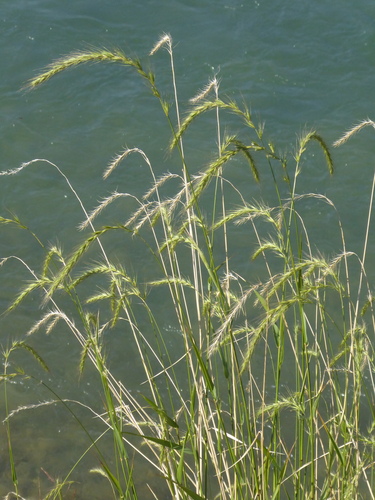
Canada Wild Rye is an elegant, native perennial bunchgrass that plays a vital role in North American prairie ecosystems. Easily recognizable by its gracefully arching, wheat-like seed heads, this cool-season grass acts as a pioneer species, rapidly colonizing disturbed soils, sandy riverbanks, and open prairies. Because it establishes quickly, it is highly valued for ecological restoration, providing critical soil stabilization and preventing erosion while slower-growing native plants take root. Beyond its practical benefits, Canada Wild Rye offers substantial aesthetic value to natural landscapes. Its blue-green foliage and dramatic, nodding spikes bring texture and movement to prairies and conservation plantings. It also serves as a crucial resource for native wildlife, providing nesting cover for birds and forage for various herbivorous insects and mammals during its early growth phases.
Lebensraum: Found in prairies, sandy shores, riverbanks, and open woodlands across North America.
This erect bunchgrass typically reaches heights of 90 to 150 centimeters, growing in dense tufts. Its leaves are flat, wide, and distinctive for their bluish-green to dark green hue, measuring up to 30 centimeters in length. The most defining feature is the nodding spike-like seed head, which curves gracefully downward under its own weight. Each spike consists of numerous spikelets adorned with long, outward-curving bristles, or awns, measuring up to 4 centimeters. As the plant matures in late summer, the entire seed head transitions from a vibrant green to a warm, straw-golden brown.
Kategorie
PflanzenSeltenheit
Common
Gefahr
1/5 · Sehr gering
Snaps
Mach den ersten Snap!
Despite its common name and rye-like appearance, it is not the wild ancestor of cultivated rye used for baking bread, which belongs to a different genus.
The bristles, or awns, on the seed heads are highly sensitive to humidity; they bend and flex as the moisture in the air shifts.
While excellent food for cattle in spring, the sharp awns on mature late-summer seed heads can cause painful physical injuries to the mouths of grazing livestock.
Develops a dense, fibrous root system that binds soil particles together, dramatically reducing wind and water erosion on vulnerable slopes.
Features long awns that twist and untwist in response to daily humidity changes, physically pushing the fallen seed into the soil surface.
Acts as an effective pioneer species by germinating and growing quickly in disturbed soils, helping to suppress invasive weeds.
As a photosynthetic plant, Canada Wild Rye produces its own energy using sunlight, carbon dioxide, water, and essential nutrients absorbed from the soil.
Bison bison
Graze on the nutritious green shoots in the early spring before the stiff seed heads develop.
Claviceps purpurea
A parasitic fungus that infects the flowers, replacing the seeds with toxic, dark purplish structures.
Poa pratensis
Competes directly for soil moisture and sunlight in restored prairie environments.
Für dieses Objekt sind noch keine Merkmal-Badges vergeben.
Noch keine Alternativnamen vorhanden.
Sammlungen für dieses Objekt erscheinen hier, wenn weitere Themen hinzugefügt werden.
Gefahr
1/5 · Sehr gering
Noch keine besonderen Sicherheitshinweise.
Der einfachste Weg, Canada Wild Rye zu bestimmen, ist die Verwendung der Naturführer-App Snappit.
90-150 cm
3-5 Jahre
As a photosynthetic plant, Canada Wild Rye produces its own energy using sunlight, carbon dioxide, water, and essential nutrients absorbed from the soil.
Found in prairies, sandy shores, riverbanks, and open woodlands across North America.
Zoome hinein, um Cluster aufzulösen und zu sehen, wo dieses Objekt fotografiert wurde.
Neueste Snaps erscheinen hier, wenn neue Beobachtungen hinzukommen.













