

Canary Catmint
nepeta teydea
The Canary Catmint (Nepeta teydea) is a striking, resilient perennial subshrub native to the high-altitude volcanic landscapes of the Canary Islands. Clinging to the rocky slopes of Tenerife and La Palma, this hardy member of the mint family thrives where few other plants can survive. It is particularly iconic in Teide National Park, where its dense, grey-green bushes add color to the barren volcanic soil. Beyond its rugged survival skills, Canary Catmint is beloved for its intensely aromatic foliage and magnificent spikes of blue-violet flowers. It plays a vital role in its local ecosystem, providing a crucial nectar source for native bees, butterflies, and other high-altitude pollinators. Its adaptation to harsh sun, low water, and freezing winter temperatures makes it a fascinating example of island evolution.
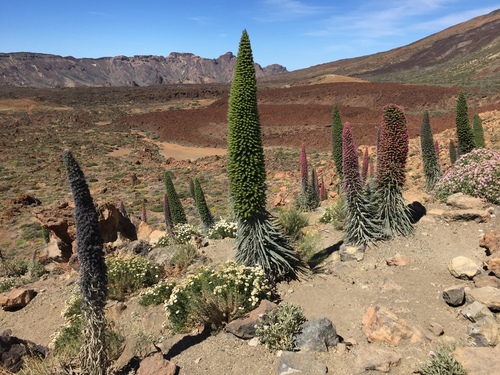
Lebensraum: Found in subalpine scrublands and open pine forests on dry, volcanic soils at elevations between 1,000 and 2,500 meters.
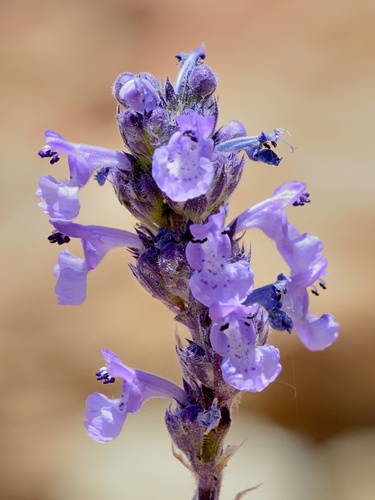
Canary Catmint forms dense, rounded woody mounds standing about 50 to 150 centimeters tall. Its lance-shaped to ovate leaves are greyish-green, highly wrinkled, and covered in fine, velvety hairs that help the plant retain moisture. During its blooming season from late spring to summer, it produces tall, upright spikes densely packed with small, tubular flowers that range from pale blue to deep violet-purple, contrasting beautifully against its muted foliage.
Kategorie
PflanzenSeltenheit
Common
Gefahr
1/5 · Sehr gering
Snaps
Mach den ersten Snap!
It is named teydea because it is a signature species of the volcanic slopes of Mount Teide, Spain's highest peak.
Like other catmints, it contains organic compounds that can elicit a playful, euphoric reaction in domestic cats.
When its leaves are bruised, they release an intense herbal, minty scent that can be detected from several feet away.
It has adapted to thrive in nutrient-poor, rocky, and highly porous volcanic substrates where other plants struggle.
Its leaves are covered in dense, fine trichomes that reflect solar radiation and significantly reduce water loss.
The plant produces strong aromatic essential oils that act as a natural deterrent against grazing animals.
As a photosynthetic plant, it produces its own energy using sunlight, carbon dioxide, and water, supplemented by minerals absorbed from volcanic soils.
Bombus canariensis
The Canary Island bumblebee feeds on its nectar and acts as a primary pollinator.
Gallotia galloti
The endemic Teide wall lizard climbs the plant to feed on its small seeds and occasionally its foliage, aiding in seed dispersal.
Für dieses Objekt sind noch keine Merkmal-Badges vergeben.
Noch keine Alternativnamen vorhanden.
Sammlungen für dieses Objekt erscheinen hier, wenn weitere Themen hinzugefügt werden.
Gefahr
1/5 · Sehr gering
Noch keine besonderen Sicherheitshinweise.
Der einfachste Weg, Canary Catmint zu bestimmen, ist die Verwendung der Naturführer-App Snappit.
50-150 cm
3-10 Jahre
As a photosynthetic plant, it produces its own energy using sunlight, carbon dioxide, and water, supplemented by minerals absorbed from volcanic soils.
Found in subalpine scrublands and open pine forests on dry, volcanic soils at elevations between 1,000 and 2,500 meters.
14-30 Tage
Zoome hinein, um Cluster aufzulösen und zu sehen, wo dieses Objekt fotografiert wurde.
Neueste Snaps erscheinen hier, wenn neue Beobachtungen hinzukommen.