

Canary Island Spurge
euphorbia canariensis
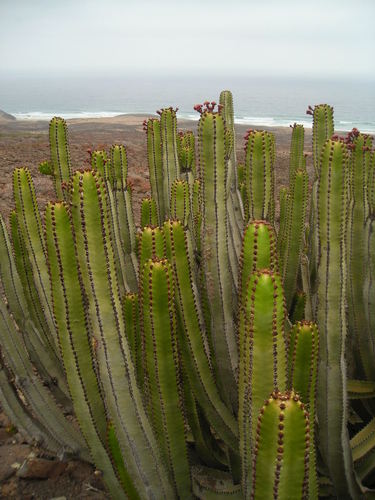
The Canary Island Spurge (Euphorbia canariensis) is a striking succulent plant, a true icon of the Canary Archipelago. It is a remarkable example of convergent evolution, having developed a cactus-like appearance despite not being related to cacti, a common adaptation to arid environments. This intriguing plant forms dense, candelabra-like clumps, dominating rocky landscapes and providing vital habitat for local fauna. Its unique biology and resilience make it a fascinating subject for both botanists and nature enthusiasts, embodying the adaptive power of island flora.
Lebensraum: Found predominantly on arid and semi-arid rocky slopes, coastal scrublands, and in ravines from sea level up to around 1000 meters across the Canary Islands.
This euphorbia presents as a robust, shrub-like succulent with numerous upright, four-angled stems branching from a thick base, forming a distinctive candelabra shape. The stems are typically green to reddish-brown, segmented, and covered with small, dark, spine-like stipules along the ridges. Small, inconspicuous reddish-yellow flowers appear along the stem ridges. When broken, the plant exudes a milky white latex. It can reach impressive heights of 2 to 4 meters, creating an imposing presence in its natural habitat.
Kategorie
PflanzenSeltenheit
Common
Gefahr
1/5 · Sehr gering
Snaps
Mach den ersten Snap!
Despite its cactus-like appearance, the Canary Island Spurge is not related to cacti; this is an excellent example of convergent evolution due to similar arid environments.
Its milky white latex, historically used by islanders as a potent purgative and fish poison, is highly toxic and can cause severe skin and eye irritation.
Locally, this plant is often referred to as 'Cardón', referencing its robust, thorny, and imposing presence in the landscape.
The plant's distinctive candelabra form is a characteristic feature of the 'cardonal-tabaibal' succulent scrubland ecosystem unique to the Canary Islands.
Its thick, fleshy stems are highly adapted to store significant amounts of water, allowing it to survive prolonged dry periods characteristic of its island habitat.
The plant produces a milky white latex that contains irritant compounds, serving as an effective defense mechanism against most herbivores attempting to feed on it.
With greatly reduced leaves, the green, succulent stems are the primary sites for photosynthesis, efficiently converting sunlight into energy in its dry environment.
As a photosynthetic plant, the Canary Island Spurge produces its own food by converting sunlight, carbon dioxide, and water into sugars, utilizing minerals absorbed from the soil.
Apis mellifera camerounensis
Pollinates the flowers, aiding in plant reproduction.
Oryctolagus cuniculus
Feeds on the plant's shoots and leaves, despite its latex.
Phylloscopus canariensis
Provides shelter and nesting sites within its dense, thorny growth.
Gallotia galloti
Consumes fruits/seeds, potentially aiding in seed dispersal.
Für dieses Objekt sind noch keine Merkmal-Badges vergeben.
Noch keine Alternativnamen vorhanden.
Sammlungen für dieses Objekt erscheinen hier, wenn weitere Themen hinzugefügt werden.
Gefahr
1/5 · Sehr gering
Noch keine besonderen Sicherheitshinweise.
Der einfachste Weg, Canary Island Spurge zu bestimmen, ist die Verwendung der Naturführer-App Snappit.
100-400 cm
5-50 kg
20-100 Jahre
As a photosynthetic plant, the Canary Island Spurge produces its own food by converting sunlight, carbon dioxide, and water into sugars, utilizing minerals absorbed from the soil.
Found predominantly on arid and semi-arid rocky slopes, coastal scrublands, and in ravines from sea level up to around 1000 meters across the Canary Islands.
Nutrient Absorption And Photosynthesis
Zoome hinein, um Cluster aufzulösen und zu sehen, wo dieses Objekt fotografiert wurde.
Neueste Snaps erscheinen hier, wenn neue Beobachtungen hinzukommen.