

Canary Islands Candle-Plant
kleinia neriifolia
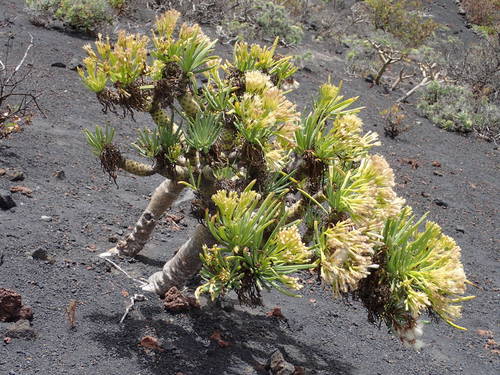
The Canary Islands Candle-Plant is an iconic succulent shrub endemic to the Canary Islands archipelago. Looking remarkably like a desert candelabra, this resilient plant is a prime example of convergent evolution, adapting to arid volcanic landscapes by mimicking the appearance of unrelated cacti or spurges. Belonging to the daisy family, it spends the hot, dry summer months in a dormant state, dropping all its leaves to conserve water. This leaves behind naked, sausage-shaped branches that resemble pale green candles. When the autumn rains arrive, the plant quickly springs to life, crowning its branches with narrow, lance-shaped leaves and clusters of fragrant, pale yellow-green blossoms.
Lebensraum: Found on dry, rocky volcanic slopes, cliffs, and arid coastal scrub zones across the Canary Islands, often growing alongside succulent Euphorbia species.
This deciduous succulent shrub typically grows between 1 and 3 meters tall, displaying thick, cylindrical, grayish-green branches that are highly jointed and marked with distinctive scars from fallen leaves. During its active winter growing season, clusters of long, narrow, lanceolate leaves form at the tips of the branches. In late summer and autumn, terminal clusters of small, brush-like, tubular white-to-yellow flowers appear, which later mature into fluffy, dandelion-like seed heads designed for wind dispersal.
Kategorie
PflanzenSeltenheit
Common
Gefahr
1/5 · Sehr gering
Snaps
Mach den ersten Snap!
Despite looking like a cactus or a succulent spurge, this plant is actually a member of the daisy and sunflower family (Asteraceae).
Its sap is a thick, sticky latex that was historically used in traditional island medicine, although it can cause skin irritation.
The scientific species name 'neriifolia' translates to 'oleander-leaved', referring to the lance-like shape of its foliage.
Drops all of its leaves during the arid summer months to drastically reduce moisture loss through transpiration.
Utilizes chlorophyll within its thick, fleshy green stems to perform photosynthesis even when completely leafless.
Stores significant volumes of water within its thick, articulated branches to survive prolonged periods of drought.
As a photosynthetic plant, it manufactures its own sugars using sunlight, carbon dioxide, and water, supplemented by minerals absorbed from volcanic soil.
Bombus canariensis
Pollinated by this endemic bee species during the plant's autumn flowering period.
Gallotia galloti
Feeds on the fallen leaves and yellow flowers, occasionally assisting in seed dispersal.
Euphorbia canariensis
Grows alongside this plant as a dominant competitor in the xerophytic cardonal-tabaibal plant communities.
Für dieses Objekt sind noch keine Merkmal-Badges vergeben.
Noch keine Alternativnamen vorhanden.
Sammlungen für dieses Objekt erscheinen hier, wenn weitere Themen hinzugefügt werden.
Gefahr
1/5 · Sehr gering
Noch keine besonderen Sicherheitshinweise.
Der einfachste Weg, Canary Islands Candle-Plant zu bestimmen, ist die Verwendung der Naturführer-App Snappit.
100-300 cm
30-100 Jahre
As a photosynthetic plant, it manufactures its own sugars using sunlight, carbon dioxide, and water, supplemented by minerals absorbed from volcanic soil.
Found on dry, rocky volcanic slopes, cliffs, and arid coastal scrub zones across the Canary Islands, often growing alongside succulent Euphorbia species.
Zoome hinein, um Cluster aufzulösen und zu sehen, wo dieses Objekt fotografiert wurde.
Neueste Snaps erscheinen hier, wenn neue Beobachtungen hinzukommen.