

Canary Tree Heath
erica canariensis
The Canary Tree Heath (Erica canariensis) is an iconic, evergreen woody plant endemic to the Macaronesian archipelago, particularly thriving across the Canary Islands and Madeira. This resilient species is a defining element of the unique 'fayal-brezal' cloud forests, where it often forms dense, wind-swept woodlands alongside the fire tree. Adapted to the cool, moisture-laden mists that sweep across high-altitude volcanic ridges, this tree heath plays an invaluable ecological role. It acts as an organic water harvester, capturing moisture from passing clouds and dripping it onto the forest floor, thereby sustaining the rich understory. In spring, it transforms the landscape into a sea of white with its profuse blooming, making it a spectacular sight for nature lovers exploring the ancient forests.
Lebensraum: Found in the humid, misty laurel forests and fayal-brezal shrublands of the Canary Islands and Madeira, typically occupying damp, high-altitude ridges.
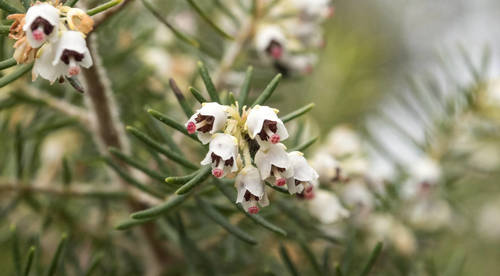
This species is a small-to-medium evergreen tree or large shrub, typically growing between 2 to 10 meters tall. It is easily identified by its dense, needle-like green leaves, which measure 3 to 5 millimeters in length and are arranged in tight whorls along the branches. The bark is deeply textured, fibrous, and reddish-brown, often peeling off in vertical strips on mature specimens. During its spectacular spring bloom, the plant is covered in countless small, pendulous, bell-shaped flowers that are white to pale pink, clustered in tight, fragrant terminal panicles.
Kategorie
PflanzenSeltenheit
Common
Gefahr
1/5 · Sehr gering
Snaps
Mach den ersten Snap!
Its dense wood is incredibly hard and heat-resistant, historically used in the region to make high-quality charcoal and smoking pipes.
Its tiny flowers are so numerous during peak bloom that entire volcanic hillsides can appear to be dusted with snow.
This species is a cornerstone of the 'fayal-brezal' ecosystem, a unique wind-swept cloud forest community endemic to Macaronesia.
Its extremely fine, needle-like foliage acts as an efficient condenser, capturing atmospheric moisture from passing clouds to drip-irrigate its own roots.
Following fires, grazing, or mechanical damage, it can rapidly regenerate from a protective lignotuber located at its root crown.
Partners with specialized ericoid mycorrhizal fungi to extract nutrients from highly acidic, nutrient-deficient volcanic soils.
As a photoautotrophic plant, it manufactures its own sugars using sunlight, water, and carbon dioxide through the process of photosynthesis.
Bombus canariensis
The endemic bumblebee visits the abundant white flowers to collect nectar and acts as a primary pollinator.
Cyclyrius webbianus
The larvae of this endemic butterfly occasionally feed on the tender young leaves and shoots of the heath tree.
Columba junoniae
Provides crucial nesting shelter and dense canopy cover within the humid laurisilva forest environment.
Für dieses Objekt sind noch keine Merkmal-Badges vergeben.
Noch keine Alternativnamen vorhanden.
Sammlungen für dieses Objekt erscheinen hier, wenn weitere Themen hinzugefügt werden.
Gefahr
1/5 · Sehr gering
Noch keine besonderen Sicherheitshinweise.
Der einfachste Weg, Canary Tree Heath zu bestimmen, ist die Verwendung der Naturführer-App Snappit.
150-1000 cm
30-150 Jahre
As a photoautotrophic plant, it manufactures its own sugars using sunlight, water, and carbon dioxide through the process of photosynthesis.
Found in the humid, misty laurel forests and fayal-brezal shrublands of the Canary Islands and Madeira, typically occupying damp, high-altitude ridges.
Zoome hinein, um Cluster aufzulösen und zu sehen, wo dieses Objekt fotografiert wurde.
Neueste Snaps erscheinen hier, wenn neue Beobachtungen hinzukommen.








.jpg&width=800)