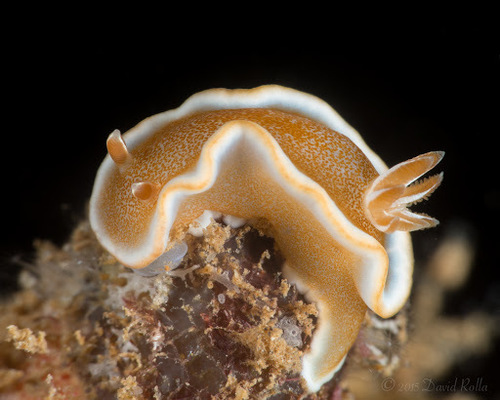


Caramel Nudibranch
glossodoris rufomarginata
The Caramel Nudibranch, scientifically known as Glossodoris rufomarginata, is a fascinating sea slug belonging to the colorful family Chromodorididae. This small marine mollusc is a vibrant inhabitant of tropical and subtropical Indo-Pacific coral and rocky reef systems. Like many nudibranchs, it is renowned for its striking appearance, which serves as a warning to potential predators of its chemical defenses. It plays a unique role in its ecosystem as a specialized sponge-eater, contributing to the delicate balance of reef communities through its selective grazing habits. Its beauty and ecological niche make it a captivating subject for underwater photographers and marine enthusiasts alike.
Lebensraum: The Caramel Nudibranch is typically found on coral and rocky reefs in subtidal zones, often crawling on or near its preferred sponge food sources.
This nudibranch typically exhibits an oblong, slightly flattened body, reaching up to 5 cm in length. Its most distinctive feature is its caramel to creamy-white body color, often adorned with a prominent, continuous rufous (reddish-brown) margin around the edge of the mantle. The rhinophores (sensory tentacles) are usually the same reddish-brown color, and the feathery gill plume, located dorsally towards the posterior, also matches this hue. Some individuals may display a network of fine white lines across the mantle or subtle darker spots, enhancing its cryptic or aposematic coloration.
Kategorie
InvertebrateSeltenheit
Common
Gefahr
1/5 · Sehr gering
Snaps
Mach den ersten Snap!
Despite their vibrant colors, nudibranchs are actually quite slow-moving, relying on their chemical defenses rather than speed to avoid predators.
Nudibranchs like the Caramel Nudibranch are hermaphroditic, meaning each individual possesses both male and female reproductive organs.
The term 'nudibranch' literally means 'naked gills', referring to their prominent, exposed respiratory structures on their backs.
They lay their eggs in striking spiral or ribbon-like masses, often deposited on the same sponges they feed on, creating intricate patterns on the reef.
Like many nudibranchs, Glossodoris rufomarginata sequesters distasteful or toxic compounds from its sponge diet, incorporating them into its tissues. This makes it unpalatable to most predators, a defense mechanism often advertised by its bright coloration (aposematism).
Its prominent rhinophores act as sophisticated chemosensory organs, allowing the nudibranch to detect chemical cues in the water. This enables it to locate its specific sponge prey and navigate its environment, despite lacking eyes capable of complex vision.
The elegant, feathery gill plume on its back provides a large surface area for efficient gas exchange in its marine environment. These gills can be retracted quickly into a pocket for protection if the animal feels threatened.
The Caramel Nudibranch is a specialized spongivore, exclusively feeding on certain species of sponges. It uses its radula (a chitinous ribbon of teeth) to scrape off and consume sponge tissue.
Dysidea spp.
The primary food source for the nudibranch, providing both nutrition and defensive compounds.
Labridae spp.
Though generally avoided due to toxicity, some specialized fish may occasionally prey on nudibranchs, especially juveniles or less toxic individuals.
Amphipoda spp.
Small crustaceans can sometimes be found living commensally or opportunistically interacting with nudibranchs, though not a direct food source or predator.
Für dieses Objekt sind noch keine Merkmal-Badges vergeben.
Noch keine Alternativnamen vorhanden.
Sammlungen für dieses Objekt erscheinen hier, wenn weitere Themen hinzugefügt werden.
Gefahr
1/5 · Sehr gering
Noch keine besonderen Sicherheitshinweise.
Der einfachste Weg, Caramel Nudibranch zu bestimmen, ist die Verwendung der Naturführer-App Snappit.
2-5 cm
0.001-0.005 kg
0-1 Jahre
The Caramel Nudibranch is a specialized spongivore, exclusively feeding on certain species of sponges. It uses its radula (a chitinous ribbon of teeth) to scrape off and consume sponge tissue.
The Caramel Nudibranch is typically found on coral and rocky reefs in subtidal zones, often crawling on or near its preferred sponge food sources.
Foraging
1000-10000
Zoome hinein, um Cluster aufzulösen und zu sehen, wo dieses Objekt fotografiert wurde.
Neueste Snaps erscheinen hier, wenn neue Beobachtungen hinzukommen.









.jpeg&width=800)