

Caribbean Bluehead Wrasse
thalassoma bifasciatum
The Caribbean Bluehead Wrasse (Thalassoma bifasciatum) is a small, vibrant fish emblematic of Caribbean coral reefs. It is renowned for its striking color variations that signify its sex and social status, undergoing a fascinating sex change from female to male. These wrasses play a crucial ecological role as a cleaner species, removing parasites from other fish, and are active foragers, contributing to the health and balance of their reef ecosystems. Their energetic presence and complex social structures make them a captivating subject for underwater observers and a vital component of the diverse marine life in the Western Atlantic.
Lebensraum: This species thrives in shallow, clear tropical waters, commonly found in coral reefs, rocky areas, and seagrass beds throughout the Caribbean Sea and Western Atlantic.
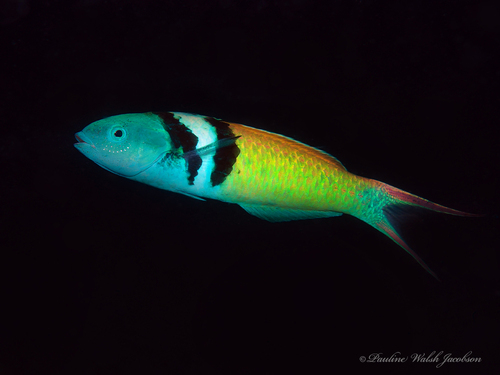
The Caribbean Bluehead Wrasse exhibits distinct color phases. Initial phase individuals, typically females and juvenile males, are yellow with a prominent dark lateral stripe running from the snout through the eye to the tail, often with a white belly. Terminal phase males, which are larger and older, display a brilliant blue head, two dark vertical bars behind the pectoral fin, and a green body that transitions to blue towards the tail. Their streamlined body shape is typical of wrasses, allowing for agile movement through complex reef structures.
Kategorie
FischeSeltenheit
Common
Gefahr
1/5 · Sehr gering
Snaps
Mach den ersten Snap!
All Bluehead Wrasses are born female; only a small percentage transition into the terminal male phase, often when a dominant male is removed from a social group.
During spawning, terminal phase males perform an elaborate courtship ritual, then release eggs and sperm into the water column in what is known as a 'spawning rush'.
Their vibrant colors and active nature make them a favorite subject for underwater photographers and snorkelers alike.
They are one of the most abundant and recognizable fish species on Caribbean reefs, playing a critical role in maintaining reef health through their cleaning and foraging activities.
Caribbean Bluehead Wrasses are protogynous hermaphrodites, meaning all individuals are born female and can transition into males later in life, often triggered by social cues like the absence of a dominant male.
Juvenile and initial phase wrasses often act as 'cleaner fish,' setting up cleaning stations where they remove ectoparasites, dead skin, and mucus from larger fish species, benefiting both parties.
They are highly active diurnal foragers, constantly darting among corals and rocks to pick off small invertebrates. This continuous scavenging makes them adept at finding hidden food sources.
The Caribbean Bluehead Wrasse has an omnivorous diet with a strong carnivorous tendency, feeding primarily on small benthic invertebrates and ectoparasites it gleans from other fish and surfaces.
Altersunterschiede: While juveniles and initial phase adults perform more cleaning services, their general diet of small invertebrates remains consistent, with opportunistic feeding on available prey.
Epinephelus striatus
The Bluehead Wrasse cleans parasites off this larger reef fish.
Sphyraena barracuda
The Bluehead Wrasse is preyed upon by this larger reef predator.
Acropora cervicornis
The Bluehead Wrasse uses coral structures for shelter and foraging.
Copepoda
The Bluehead Wrasse consumes these small organisms as part of its diet.
Für dieses Objekt sind noch keine Merkmal-Badges vergeben.
Noch keine Alternativnamen vorhanden.
Sammlungen für dieses Objekt erscheinen hier, wenn weitere Themen hinzugefügt werden.
Gefahr
1/5 · Sehr gering
Noch keine besonderen Sicherheitshinweise.
Der einfachste Weg, Caribbean Bluehead Wrasse zu bestimmen, ist die Verwendung der Naturführer-App Snappit.
5-15 cm
0.005-0.08 kg
2-5 Jahre
The Caribbean Bluehead Wrasse has an omnivorous diet with a strong carnivorous tendency, feeding primarily on small benthic invertebrates and ectoparasites it gleans from other fish and surfaces.
This species thrives in shallow, clear tropical waters, commonly found in coral reefs, rocky areas, and seagrass beds throughout the Caribbean Sea and Western Atlantic.
Foraging
10000-50000
Zoome hinein, um Cluster aufzulösen und zu sehen, wo dieses Objekt fotografiert wurde.
Neueste Snaps erscheinen hier, wenn neue Beobachtungen hinzukommen.