

Carolina Buckthorn
frangula caroliniana
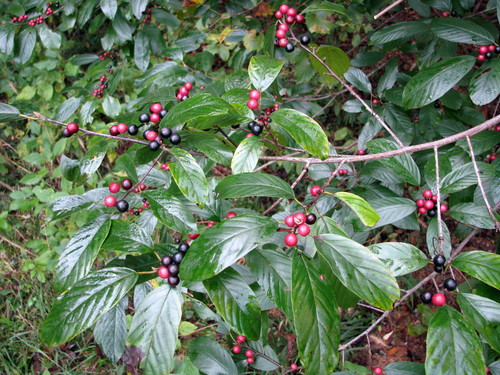
Carolina Buckthorn (Frangula caroliniana) is an elegant deciduous small tree or large shrub native to the southeastern and south-central United States. Despite its common name, it is entirely thornless, boasting a handsome, spreading canopy that blends gracefully into woodland borders, limestone glades, and riparian zones. It is highly valued in native landscaping for its glossy green foliage and its exceptional ability to thrive in alkaline soils where other plants might struggle. This species plays a vital role in local ecosystems, acting as a sanctuary and food source for various wildlife. During the late summer and autumn, it produces abundant berries that transition through a beautiful color palette from green to vibrant red, and finally to a rich, glossy black. These berries serve as an essential food reserve for migrating birds and local mammals preparing for the winter season.
Lebensraum: Found in rich deciduous woodlands, rocky limestone ridges, glades, and stream banks throughout the southeastern United States.
This elegant shrub or small tree typically reaches heights of 3 to 9 meters. It features simple, alternately arranged, oblong-elliptic leaves that are 5 to 15 cm long with distinctive, prominent parallel veins running from the midrib to the finely serrated margins. The leaves are a lustrous dark green on top and paler underneath, turning yellow in autumn. In spring, it bears inconspicuous, greenish-yellow, cup-shaped flowers. These are followed by showy, berry-like drupes that turn from yellow-green to rose-red, and finally mature to a glossy black color.
Kategorie
PflanzenSeltenheit
Common
Gefahr
1/5 · Sehr gering
Snaps
Mach den ersten Snap!
Despite its common name of 'buckthorn', this species is completely thornless and safe to touch.
Its wood is exceptionally dense and was historically used to make high-grade charcoal for gunpowder production.
The ripening fruits present a striking multi-colored display, as green, red, and black berries often appear on the same branch simultaneously.
Thrives in nutrient-poor calcareous soils and limestone outcroppings where many other woody species cannot survive.
Produces highly visible, multi-colored berries that attract birds, which ingest the seeds and deposit them elsewhere to facilitate reproduction.
Deters heavy mammalian herbivory through mild emetic chemical compounds in its bark and foliage.
As a photoautotrophic plant, it manufactures its own organic compounds using sunlight, water, and carbon dioxide through photosynthesis.
Cardinalis cardinalis
Eats the mature black berries and aids in seed dispersal.
Strymon melinus
Feeds on the leaves as a larval host plant.
Odocoileus virginianus
Occasionally browses the twigs and foliage during winter.
Für dieses Objekt sind noch keine Merkmal-Badges vergeben.
Noch keine Alternativnamen vorhanden.
Sammlungen für dieses Objekt erscheinen hier, wenn weitere Themen hinzugefügt werden.
Gefahr
1/5 · Sehr gering
Noch keine besonderen Sicherheitshinweise.
Der einfachste Weg, Carolina Buckthorn zu bestimmen, ist die Verwendung der Naturführer-App Snappit.
300+ cm
15+ Jahre
As a photoautotrophic plant, it manufactures its own organic compounds using sunlight, water, and carbon dioxide through photosynthesis.
Found in rich deciduous woodlands, rocky limestone ridges, glades, and stream banks throughout the southeastern United States.
Photosynthesis
Zoome hinein, um Cluster aufzulösen und zu sehen, wo dieses Objekt fotografiert wurde.
Neueste Snaps erscheinen hier, wenn neue Beobachtungen hinzukommen.

Arkansas, US
Hier kann man sehen Regenbogenforelle und Sassafras-Schwalbenschwanz.
Führer anzeigen →
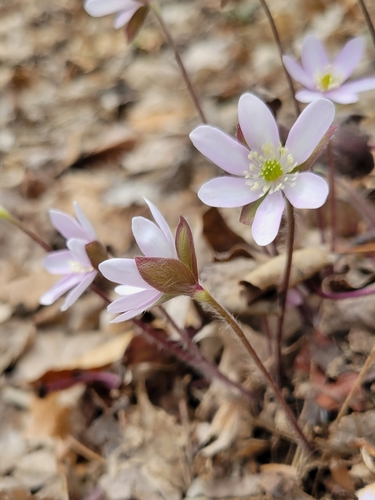
Tennessee, US
Hier kann man sehen Sharp-Lobed Hepatica und Nördlicher Schleim-Salamander.
Führer anzeigen →



.jpg&width=800)









