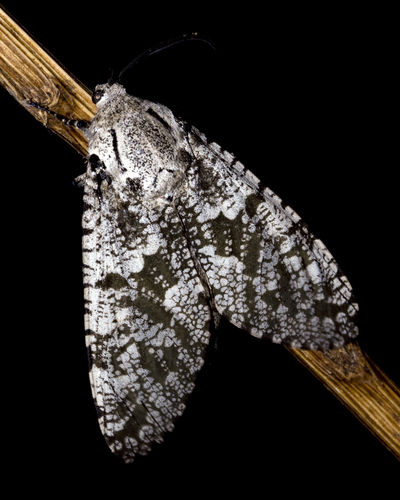


Carpenterworm Moth
prionoxystus robiniae
The Carpenterworm Moth (Prionoxystus robiniae) is a large, stout-bodied moth belonging to the family Cossidae, commonly known as carpenter miller moths. It is widely distributed across North America, where it is best known for its wood-boring larval stage. While the adult moths are cryptically colored and rarely seen during the day, their presence is often given away by the sap-oozing tunnels they leave behind in mature hardwood trees. Interestingly, the adults do not feed at all, living just long enough to locate a mate and deposit eggs on host bark.
Lebensraum: Found in deciduous forests, woodlots, orchards, and urban parks with abundant mature hardwood trees.
Adult Carpenterworm Moths are heavy-bodied and covered in dense, insulating scales. Their forewings are intricately patterned with mottled gray, black, and white, perfectly mimicking rough tree bark. Females are significantly larger than males, with a wingspan reaching up to 9 centimeters, and feature dusky gray hindwings. Males, which are smaller and more active flyers, have distinct, bright orange-to-yellow hindwings bordered in black, which can be seen in flight as a startle signal to potential predators.
Kategorie
InsektenSeltenheit
Common
Gefahr
1/5 · Sehr gering
Snaps
Mach den ersten Snap!
Adult Carpenterworm Moths have no functional mouthparts; they live entirely off fat stored during their larval years, surviving only a few days to mate.
Before emerging as adults, the pupae wriggle to the outer exit of their tunnels, often leaving empty pupal skins protruding from the tree's bark.
Male moths fly rapidly during the day and evening in search of females, using their bright orange hindwings as warning colors to potential predators.
The larvae can spend up to three years chewing through solid hardwood before they are fully grown and ready to pupate.
Larvae possess exceptionally powerful, hardened mouthparts that allow them to chew directly through solid, living hardwood trees.
The intricate gray and black patterns on the forewings make adults virtually invisible when resting on the bark of host trees.
Adults emerge with non-functional mouthparts and digestive systems, allowing them to bypass the need to feed and focus entirely on reproduction.
The larvae feed on the inner bark, sapwood, and heartwood of various deciduous trees, while the adult moths do not feed at all.
Robinia pseudoacacia
The larvae feed extensively on the wood of this tree, making it one of the species' primary hosts.
Dryobates pubescens
This bird actively seeks out and excavates the large larvae from beneath the bark of infested trees.
Quercus rubra
The moth frequently utilizes this hardwood species as a host for larval development.
Für dieses Objekt sind noch keine Merkmal-Badges vergeben.
Noch keine Alternativnamen vorhanden.
Sammlungen für dieses Objekt erscheinen hier, wenn weitere Themen hinzugefügt werden.
Gefahr
1/5 · Sehr gering
Noch keine besonderen Sicherheitshinweise.
Der einfachste Weg, Carpenterworm Moth zu bestimmen, ist die Verwendung der Naturführer-App Snappit.
3+ cm
4+ cm
0.001+ kg
1+ Jahre
The larvae feed on the inner bark, sapwood, and heartwood of various deciduous trees, while the adult moths do not feed at all.
Found in deciduous forests, woodlots, orchards, and urban parks with abundant mature hardwood trees.
Foraging Wood Boring Only In Larvae Stage Adults Do Not Feed At All And Have No Functional Mouthparts Relying On Larval Fat Reserves To Survive And Mate During Their Short Adulthood Which Lasts Only A Few Days After Emergence From The Tree Trunk Tunnels Which They Created As Caterpillars Over Several Years Of Feeding On The Heartwood Of Host Trees Until They Pupate And Emerge As Adult Moths During The Summer Months Of The Year Which Is Their Only Flight Period Before Dying Of Starvation And Exhaustion From Mating Activities In Their Short Adult Life Cycle Duration Of Less Than A Week On Average In The Wild Environment Of North America Where They Are Found Commonly Across Most States And Provinces Of The Continent Particularly In Areas With Dense Forests Or Urban Parks Containing Large Hardwood Trees Such As Oaks And Ashes Which Are Their Preferred Host Plants For Egg Deposition And Larval Development Processes Occurring Under The Bark Surface Where They Are Protected From Most Predators And Harsh Weather Conditions During The Cold Winter Months Of The Year When They Are Dormant And Not Actively Feeding On The Wood Fibers Of The Tree Trunk Or Branches Which Can Lead To Structural Weakness And Eventual Breakage Of The Affected Limbs Or The Entire Tree If The Infestation Is Severe Enough To Girdle The Vascular System Of The Host Plant Itself And Cause It To Die Back From The Top Downward Over Several Years Of Continuous Larval Activity Within The Wood Tissue Matrix Layers Of The Trunk And Main Branches Of The Infested Specimen Tree In The Area Where The Moths Are Active And Breeding Regularly To Maintain Their Population Levels In The Local Ecosystem Without Causing Widespread Damage To The Entire Forest Stand Unless Other Stressors Are Present To Weaken The Trees Further And Make Them More Susceptible To Attacks By These Wood Boring Insects Which Are Part Of The Natural Decay And Succession Process In Forests Worldwide By Recycling Nutrients And Creating Nesting Sites For Birds And Other Animals That Use The Hollow Chambers Left Behind By The Moths After They Have Emerged As Adults Into The Open Air To Start The Cycle Anew With The Next Generation Of Carpenterworms Which Will Continue The Process Of Wood Consumption And Tunneling In The Same Or Nearby Trees For Years To Come Until They Too Metamorphose Into Winged Adults Capable Of Flight And Reproduction In The Summer Season Of Their Respective Emergence Year From Their Long Larval Developmental Period Within The Heart Of The Wood Tissue Fibers Themselves Which Provides Both Food And Shelter For Them
Zoome hinein, um Cluster aufzulösen und zu sehen, wo dieses Objekt fotografiert wurde.
Neueste Snaps erscheinen hier, wenn neue Beobachtungen hinzukommen.









_G._Bocskay_1562_J._Hoefnagel_illumination_1596_Ms.20_(86.MV.527)_fol._101_Horntail_Caterpillar%2C_Eyed_Hawk-Moth%2C_Beetle%2C_Two-Spot_Ladybird_(Getty_Museum).jpg&width=800)