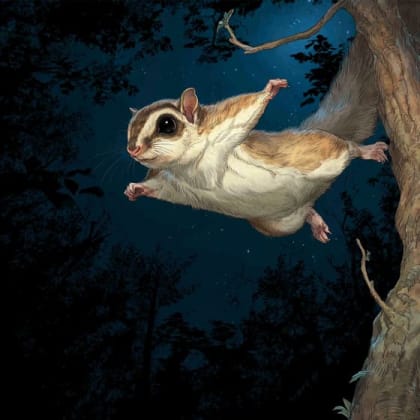
Caucasian Squirrel
Sciurus anomalus
Caucasian squirrels are small, fluffy creatures with bushy tails. They love to climb trees and gather nuts to eat. You can often see them playing in parks and forests!
Lebensraum: Forests
The Caucasian Squirrel has a sleek body with fur that is typically grayish-brown on its back, often tinged with reddish hues. Its belly ranges from pale yellowish-white to a richer reddish-orange, contrasting with its back. A large, bushy tail, often matching its back color, helps distinguish it visually from other squirrels.
Kategorie
SäugetiereSeltenheit
Common
Gefahr
1/5 · Sehr gering
Snaps
Mach den ersten Snap!
A group of squirrels is sometimes called a 'scurry' – how fun is that?
Their front teeth never stop growing, so they chew constantly to keep them sharp!
These squirrels can rotate their ankles almost 180 degrees to climb down trees headfirst!
They build cozy nests, called 'dreys,' high in trees using leaves and twigs.
Caucasian Squirrel can quickly scale trees and navigate branches with ease because of its strong claws and powerful hind legs.
Caucasian Squirrel has an excellent memory that helps them find buried nuts and seeds stored for leaner times.
Caucasian Squirrel uses its long, bushy tail as a counterweight that helps them maintain balance while leaping between tree limbs.
A hungry omnivore, this squirrel enjoys a mix of nuts, fruits, and sometimes even insects!
Bubo bubo
Hunted by this large nocturnal predator.
Martes martes
A swift arboreal hunter that preys on squirrels.
Felis silvestris
Occasional prey for this stealthy feline.

Corylus avellana
Relies on its nuts for a major food source.
Quercus robur
Uses acorns as a vital food supply.
Pelzig beschreibt Tiere, die eine dichte Schicht aus weichen Haaren oder Fell besitzen.
Soziale Tiere leben in organisierten Gruppen und kooperieren, um ihr Überleben zu sichern, beispielsweise bei der Nahrungssuche, Verteidigung und Aufzucht der Jungen.
Baumbewohnende Tiere leben hauptsächlich in Bäumen und nutzen diese als Unterschlupf, Nahrungsquelle und zum Schutz vor Raubtieren.
Dieses Merkmal kennzeichnet Lebewesen, deren Ernährung vollständig oder hauptsächlich aus pflanzlichem Material besteht.

Waldlebensräume sind terrestrische Lebensräume, die von dichtem Baumbestand dominiert werden und eine große Vielfalt an Pflanzen- und Tierarten beherbergen.

Dieses Merkmal kennzeichnet Lebewesen, die bei der Jagd, Flucht oder Fortbewegung eine außergewöhnliche Schnelligkeit aufweisen.

Tagaktive Tiere sind hauptsächlich bei Tageslicht aktiv und ruhen oder schlafen in der Regel nachts.
Noch keine Alternativnamen vorhanden.
Gefahr
1/5 · Sehr gering
It's best to watch squirrels from a distance and not try to touch or feed them.
20-25 cm
0.22-0.4 kg
6-10 Jahre
24 km/h
A hungry omnivore, this squirrel enjoys a mix of nuts, fruits, and sometimes even insects!
Forests
Foraging
2-7
Zoome hinein, um Cluster aufzulösen und zu sehen, wo dieses Objekt fotografiert wurde.
Neueste Snaps erscheinen hier, wenn neue Beobachtungen hinzukommen.