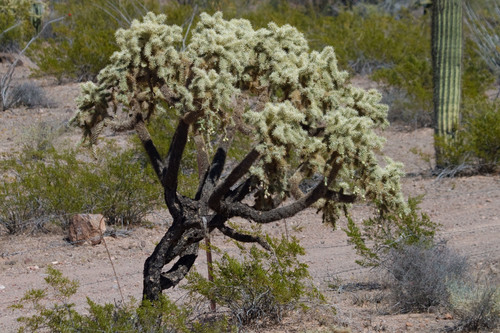


Chain-Fruit Cholla
cylindropuntia fulgida
The Chain-Fruit Cholla (Cylindropuntia fulgida), also commonly known as the jumping cholla, is one of the most iconic and formidable cacti of the Sonoran Desert. Growing as a shrubby, tree-like cactus, it captivates onlookers with its hanging, interconnected chains of green, pear-shaped fruit that accumulate year after year. Despite its beautiful, shimmering appearance in the desert sun, it is famous for its fiercely barbed spines that easily attach to any passing traveler. This cactus plays an incredibly vital role in the desert ecosystem, offering highly secure nesting sites for desert birds and building materials for ingenious woodrats. Its ability to thrive in extremely arid environments through efficient water storage and vegetative cloning makes it a resilient masterpiece of evolutionary adaptation.
Lebensraum: Found in desert flats, gravelly slopes, and arid valleys of the Sonoran Desert.
This tree-like cactus typically stands between 100 and 400 centimeters tall, featuring a dark, woody trunk and numerous cylindrical, jointed branches. The branches are covered in a dense, shimmering forest of silver-to-yellow spines that catch the light, giving the plant a glowing halo appearance. Its pink-to-magenta flowers bloom in the summer, giving way to smooth, spineless green fruits. These fruits do not fall off; instead, new flowers and fruits grow directly from the old ones, creating long, drooping chains that can reach up to 60 centimeters in length.
Kategorie
PflanzenSeltenheit
Common
Gefahr
1/5 · Sehr gering
Snaps
Mach den ersten Snap!
Because the seeds of the chain-fruit cholla are almost always sterile, nearly every plant you see is a genetic clone of its parent.
Despite its nickname 'jumping cholla', the cactus cannot actually jump; its segments simply detach with such minimal force that they seem to leap onto passersby.
The drooping chains of green fruit can remain attached to the mother plant for over twenty years, continually growing new fruits from the old ones.
Detached joints and hanging fruit chains easily take root upon falling to the ground, allowing the plant to propagate effectively without relying on seeds.
The spines feature microscopic, backward-facing barbs that effortlessly grip animal hide or clothing, facilitating long-distance dispersal of stem segments.
It utilizes Crassulacean Acid Metabolism to open its stomata only at night, drastically reducing water loss in the scorching desert heat.
As a photoautotroph, the chain-fruit cholla produces its own energy using sunlight, carbon dioxide, and water through photosynthesis.
Campylorhynchus brunneicapillus
The Cactus Wren builds its nests deep within the heavily armed branches of the cholla for absolute predator protection.
Neotoma albigula
White-throated packrats collect fallen spiny joints to construct impenetrable defensive mounds around their nests and eat the fruits.
Diadasia rinconis
The Cactus Bee feeds on the nectar and pollen of the cholla's pink-to-magenta summer blooms, aiding in cross-pollination.
Für dieses Objekt sind noch keine Merkmal-Badges vergeben.
Noch keine Alternativnamen vorhanden.
Sammlungen für dieses Objekt erscheinen hier, wenn weitere Themen hinzugefügt werden.
Gefahr
1/5 · Sehr gering
Noch keine besonderen Sicherheitshinweise.
Der einfachste Weg, Chain-Fruit Cholla zu bestimmen, ist die Verwendung der Naturführer-App Snappit.
100-400 cm
20-250 kg
30-80 Jahre
As a photoautotroph, the chain-fruit cholla produces its own energy using sunlight, carbon dioxide, and water through photosynthesis.
Found in desert flats, gravelly slopes, and arid valleys of the Sonoran Desert.
Zoome hinein, um Cluster aufzulösen und zu sehen, wo dieses Objekt fotografiert wurde.
Neueste Snaps erscheinen hier, wenn neue Beobachtungen hinzukommen.