

Charcoal Eyelash
anthracobia melaloma
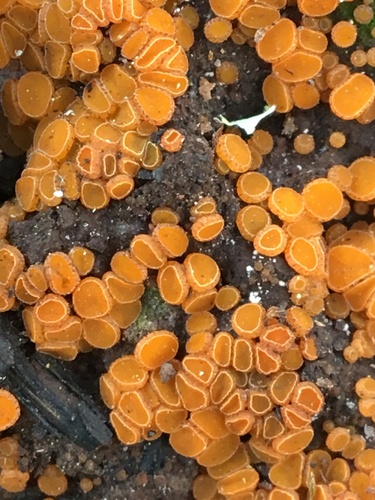
The Charcoal Eyelash (Anthracobia melaloma) is a fascinating pyrophilous (fire-loving) cup fungus that plays a vital role in forest recovery. Appearing as tiny, vibrant orange discs, this resilient species is one of the first colonizers of freshly charred soil and bonfire sites. It thrives in the harsh, ash-rich environment left behind by forest fires, where other organisms struggle to survive. By feeding on burnt organic matter, this fungus initiates the decomposition process and helps prepare the sterile post-fire ground for the return of plant life. Its ability to quickly populate desolate, carbon-rich landscapes makes it a remarkable symbol of ecological renewal.
Lebensraum: Found primarily on burnt ground, charcoal remnants, and bonfire sites in both forested and open areas.
This fungus forms tiny, cup-shaped or flat disc-like structures measuring only 1 to 5 millimeters in diameter. They are bright orange, orange-yellow, or brownish-orange in color. The defining feature is the margin of the disc, which is lined with short, dark brown or blackish hairs that resemble tiny eyelashes. These small cups typically grow crowded together in dense, eye-catching clusters directly on blackened charcoal and ash.
Kategorie
PilzeSeltenheit
Common
Gefahr
1/5 · Sehr gering
Snaps
Mach den ersten Snap!
The spores of this fungus actually germinate much better after being exposed to extreme heat or fire-related chemicals.
The tiny dark hairs on the edges of the cups look so much like eyelashes that they inspired the common name 'Charcoal Eyelash'.
They help prevent soil erosion after forest fires by binding the loose ash and soil with their microscopic network of root-like mycelium.
Thrives exclusively on recently burned soil and charcoal, utilizing post-fire nutrients that are hostile to most other fungal species.
The dark, protective hairs lining its cup margins help retain moisture and protect the delicate spore-producing surface from dry air.
Utilizes pressurized microscopic sacs to actively shoot spores into the wind, ensuring rapid colonization of distant burn sites.
As a saprotrophic fungus, it decomposes organic matter in charred soils, extracting nutrients from carbonized plant remains.
Funaria hygrometrica
Frequently shares post-fire ground, helping to stabilize the ash-rich soil and retain moisture.
Hypogastrura viatica
Feeds on the spores and delicate mycelial threads of the fungus in burnt environments.
Für dieses Objekt sind noch keine Merkmal-Badges vergeben.
Noch keine Alternativnamen vorhanden.
Sammlungen für dieses Objekt erscheinen hier, wenn weitere Themen hinzugefügt werden.
Gefahr
1/5 · Sehr gering
Noch keine besonderen Sicherheitshinweise.
Der einfachste Weg, Charcoal Eyelash zu bestimmen, ist die Verwendung der Naturführer-App Snappit.
0 cm
As a saprotrophic fungus, it decomposes organic matter in charred soils, extracting nutrients from carbonized plant remains.
Found primarily on burnt ground, charcoal remnants, and bonfire sites in both forested and open areas.
Zoome hinein, um Cluster aufzulösen und zu sehen, wo dieses Objekt fotografiert wurde.
Neueste Snaps erscheinen hier, wenn neue Beobachtungen hinzukommen.