

Cherry And Unmarked Daggers And Allies
acronicta hasta
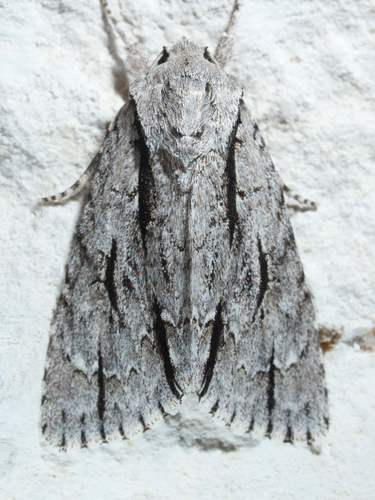
The Speared Dagger Moth (Acronicta hasta), often grouped with cherry and unmarked daggers, is a fascinating member of the Noctuidae family. Found throughout the deciduous forests and suburban landscapes of North America, this insect leads a double life. As a caterpillar, it is a voracious consumer of foliage, particularly favoring cherry and plum trees. As an adult, it transforms into a master of disguise, utilizing complex gray and black wing patterns to blend seamlessly into the rough bark of trees. This cryptic coloration allows the moth to evade daytime predators like birds. While they might easily go unnoticed by the casual observer, uncovering one resting on a trunk is a rewarding experience for any nature enthusiast, showcasing the incredible adaptations of nocturnal Lepidoptera.
Lebensraum: Typically found in deciduous woodlands, forest edges, orchards, and suburban gardens where host trees like cherry and plum are abundant.
Adults of Acronicta hasta possess a wingspan of approximately 3 to 5 centimeters and exhibit a stunning mottled gray and charcoal pattern on their forewings. These wings are decorated with distinct, dark, dagger-like dashes—a hallmark of the Acronicta genus—with one particularly sharp, spear-like mark giving the species its scientific name. Their hindwings are slightly paler, often a pale gray or off-white with faint darker veining. The caterpillars are equally distinctive, featuring a dark body adorned with tufts of contrasting setae (hairs) and bold spots that serve as a warning to potential predators.
Kategorie
InsektenSeltenheit
Common
Gefahr
1/5 · Sehr gering
Snaps
Mach den ersten Snap!
Despite their delicate appearance as adults, the caterpillars are eating machines, capable of consuming several times their own body weight in cherry leaves daily.
Like many dagger moths, the adults rest head-downward on tree trunks during the day to perfectly align their wing patterns with the vertical grooves of the bark.
The scientific name 'hasta' translates to 'spear' in Latin, referring to the sharp, dagger-like black markings on the adult moth's forewings.
Adults have wing patterns that perfectly mimic the texture and coloration of tree bark, rendering them nearly invisible to daytime predators.
The larvae possess tufts of bristle-like hairs that can irritate predators, discouraging birds and other animals from eating them.
Females release highly specialized chemical pheromones to attract mates over long distances through the dense nighttime forest.
Larvae feed extensively on the foliage of deciduous trees, while adult moths consume minimal sustenance, occasionally sipping nectar.
Altersunterschiede: Larvae are entirely folivorous, whereas adults switch to a liquid diet of nectar or may not feed at all.
Prunus serotina
Primary host plant for the developing larvae.
Megascops asio
Predator that commonly hunts flying nocturnal moths.
Cotesia congregata
Parasitoid wasp that lays its eggs inside the moth's caterpillars.
Für dieses Objekt sind noch keine Merkmal-Badges vergeben.
Noch keine Alternativnamen vorhanden.
Sammlungen für dieses Objekt erscheinen hier, wenn weitere Themen hinzugefügt werden.
Gefahr
1/5 · Sehr gering
Noch keine besonderen Sicherheitshinweise.
Der einfachste Weg, Cherry And Unmarked Daggers And Allies zu bestimmen, ist die Verwendung der Naturführer-App Snappit.
1-3 cm
3-5 cm
0.001-0.003 kg
0-1 Jahre
Larvae feed extensively on the foliage of deciduous trees, while adult moths consume minimal sustenance, occasionally sipping nectar.
Typically found in deciduous woodlands, forest edges, orchards, and suburban gardens where host trees like cherry and plum are abundant.
Foraging
Zoome hinein, um Cluster aufzulösen und zu sehen, wo dieses Objekt fotografiert wurde.
Neueste Snaps erscheinen hier, wenn neue Beobachtungen hinzukommen.