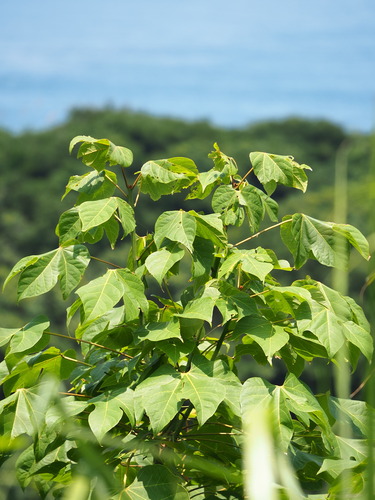


Chinese Parasol Tree
firmiana simplex
The Chinese Parasol Tree (Firmiana simplex) is an ornamental deciduous tree renowned for its smooth, bright green bark and massive, maple-like leaves that resemble parasols. Native to East Asia, it has been cultivated for centuries in temple gardens and urban landscapes. Its rapid growth and dramatic tropical appearance make it a favorite for shade-seekers, though in some regions outside its native range, it can spread vigorously and is classified as an opportunistic weed. During mid-summer, it erupts in large, airy clusters of yellow-green flowers, followed by unique seedpods that open into leaf-like structures before dropping, creating an enchanting spectacle throughout the seasons.
Lebensraum: Typically found in lowland valleys, mountain slopes, riparian corridors, and widely planted in urban parks and residential gardens.
This medium-sized deciduous tree typically grows up to 15 meters tall, instantly recognizable by its unusually smooth, lime-green bark that remains green even as the tree matures. Its alternate, palmately lobed leaves are immense, spanning up to 30 centimeters across, with 3 to 5 pointed lobes. In summer, it produces terminal panicles of tiny, petalless, lemon-yellow flowers. The subsequent seedpods are paper-like and split into four or five leaf-like sections, each bearing small, round, pea-sized seeds along their margins.
Kategorie
PflanzenSeltenheit
Common
Gefahr
1/5 · Sehr gering
Snaps
Mach den ersten Snap!
In Chinese mythology, the legendary Phoenix (Fenghuang) is said to only perch upon the branches of the Chinese Parasol Tree, symbolizing peace and prosperity.
Its wood is highly resonant and has been traditionally used in China to construct the soundboards of classical stringed instruments like the guqin and guzheng.
The seeds of the tree are rich in oil and can be roasted to create a popular beverage that tastes remarkably similar to coffee.
The smooth green bark contains active chlorophyll, allowing the tree to photosynthesize and generate energy even during winter when it is completely leafless.
Its seed capsules split open into light, papery, leaf-like sails that easily catch the wind, ensuring the seeds travel far from the parent tree.
It possesses a vigorous root system and the ability to sprout quickly from stumps, allowing it to recover rapidly from physical damage.
Like all green plants, the Chinese Parasol Tree produces its own food through photosynthesis, utilizing sunlight, carbon dioxide, water, and essential nutrients drawn from the soil.
Popillia japonica
The leaves are heavily browsed by Japanese Beetle adults, causing skeletonization.
Apis mellifera
The showy, fragrant flowers attract honey bees for nectar and pollen collection.
Für dieses Objekt sind noch keine Merkmal-Badges vergeben.
Noch keine Alternativnamen vorhanden.
Sammlungen für dieses Objekt erscheinen hier, wenn weitere Themen hinzugefügt werden.
Gefahr
1/5 · Sehr gering
Noch keine besonderen Sicherheitshinweise.
Der einfachste Weg, Chinese Parasol Tree zu bestimmen, ist die Verwendung der Naturführer-App Snappit.
1000+ cm
Like all green plants, the Chinese Parasol Tree produces its own food through photosynthesis, utilizing sunlight, carbon dioxide, water, and essential nutrients drawn from the soil.
Typically found in lowland valleys, mountain slopes, riparian corridors, and widely planted in urban parks and residential gardens.
Zoome hinein, um Cluster aufzulösen und zu sehen, wo dieses Objekt fotografiert wurde.
Neueste Snaps erscheinen hier, wenn neue Beobachtungen hinzukommen.

Louisiana, US
Hier kann man sehen Mississippi River Wakerobin und Leierblatt-Salbei.
Führer anzeigen →

Alabama, US
Hier kann man sehen Weißwedelhirsch, Rotfuchs und östliches Grauhörnchen.
Führer anzeigen →














