

Chlorosplenium Chlora
chlorosplenium chlora
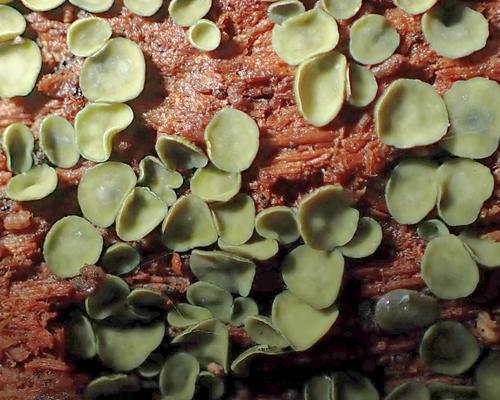
Chlorosplenium Chlora is a captivating cup fungus that brings a brilliant splash of color to damp, decaying woodlands. Growing on the barkless decaying wood of deciduous trees, this tiny, cup-shaped fungus plays a vital role as a decomposer, breaking down complex organic materials and recycling nutrients back into the forest soil. While easily overlooked due to its diminutive size, a close inspection reveals bright sulfur-yellow to yellow-green cups that look like tiny gems scattered across rotting logs. Its ability to stain the underlying wood with its vibrant pigments makes it a fascinating subject for mushroom enthusiasts and forest ecologists alike.
Lebensraum: Typically found in damp deciduous forests, growing on the decaying, barkless logs and branches of hardwood trees.
This fungus produces tiny, cup-shaped or saucer-shaped fruiting bodies that measure between 1 to 5 millimeters in diameter. The fertile inner surface of the cup is a striking bright yellow, sulfur-yellow, or yellowish-green, while the outer surface is slightly paler or powdery. These cups can be sessile (attached directly) or feature a very short stalk, often appearing clustered together in large groups on damp, decayed hardwood.
Kategorie
PilzeSeltenheit
Common
Gefahr
1/5 · Sehr gering
Snaps
Mach den ersten Snap!
Like its close relative the green elfcup, wood stained by this genus has historically been prized by woodworkers for intricate marquetry and woodwork inlaying.
The cups are extremely sensitive to humidity and will shrivel up when dry, only to rehydrate and swell back up when rain returns.
The vibrant yellow-green pigment produced by this fungus can deeply stain the wood it colonizes, lasting long after the fungus itself has withered.
Releases a vibrant yellowish-green pigment that penetrates and colors the surrounding host wood fibers.
Secretes specialized enzymes that efficiently break down tough lignin and cellulose in dead wood.
Uses pressurized microscopic sacs called asci to actively shoot spores into passing wind currents.
As a saprotrophic fungus, it obtains nutrients by decomposing dead hardwood, breaking down cellulose and lignin.
Quercus alba
Grows on and decomposes the fallen logs and branches of this tree.
Collembola
Feeds on the spores and fruiting bodies of the fungus.
Chlorociboria aeruginascens
Competes for space and resources on decaying hardwood logs.
Für dieses Objekt sind noch keine Merkmal-Badges vergeben.
Noch keine Alternativnamen vorhanden.
Sammlungen für dieses Objekt erscheinen hier, wenn weitere Themen hinzugefügt werden.
Gefahr
1/5 · Sehr gering
Noch keine besonderen Sicherheitshinweise.
Der einfachste Weg, Chlorosplenium Chlora zu bestimmen, ist die Verwendung der Naturführer-App Snappit.
0 cm
0 kg
1-5 Jahre
As a saprotrophic fungus, it obtains nutrients by decomposing dead hardwood, breaking down cellulose and lignin.
Typically found in damp deciduous forests, growing on the decaying, barkless logs and branches of hardwood trees.
Absorption
10-30 Tage
Zoome hinein, um Cluster aufzulösen und zu sehen, wo dieses Objekt fotografiert wurde.
Neueste Snaps erscheinen hier, wenn neue Beobachtungen hinzukommen.









.jpg&width=800)




