

Christmas Lichen
herpothallon rubrocinctum
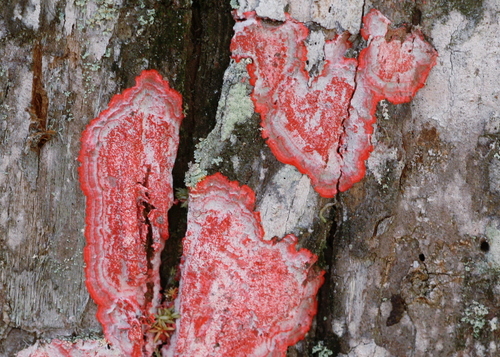
The Christmas Lichen (Herpothallon rubrocinctum) is a stunning and eye-catching species that brings festive colors to humid forests year-round. Named for its striking combination of bright red borders and cool, pale-green centers, this unique organism is not a single plant but a symbiotic partnership between a fungus and a photosynthetic alga. It forms delicate, felt-like patches on the trunks of hardwood trees in subtropical regions, brightening up shaded forest understories. Beyond its beautiful holiday-like appearance, the Christmas Lichen serves as an important ecological indicator. Because lichens absorb nutrients directly from the air and rain rather than from roots, they are highly sensitive to atmospheric quality. Spotting a vibrant patch of Christmas Lichen is a wonderful sign that the local air is clean and the forest ecosystem is thriving and undisturbed. It remains a favorite find for nature enthusiasts exploring wet woodlands and cypress swamps.
Lebensraum: Found on the shaded bark of hardwood trees in highly humid, subtropical environments such as cypress swamps and hammocks.
This species is easily recognized by its distinctive circular or irregular flat patches with a powdery, felt-like texture. The central region of the lichen is a pale greenish-gray to white, which is sharply contrasted by a bright, vibrant crimson-red or pink border. It can grow from a few centimeters to over 15 centimeters in diameter on tree bark, with the bright red coloration originating from a specialized chemical compound known as chiodonic acid.
Kategorie
PilzeSeltenheit
Common
Gefahr
1/5 · Sehr gering
Snaps
Mach den ersten Snap!
Because it has no root system, this lichen relies entirely on clean air and rain for survival, making it a natural air quality monitor.
Its festive red-and-green coloration makes it look like a holiday decoration growing naturally on tree bark.
The bright red chemical, chiodonic acid, also acts as a natural deterrent against hungry herbivores like snails and mites.
Combines a fungal structure with photosynthetic algae to survive on bare bark without soil.
Produces chiodonic acid, a bright red pigment that protects the organism from harmful ultraviolet radiation.
Possesses a poikilohydric nature, enabling it to absorb moisture and dissolved nutrients directly from humid air.
Produces its own food through photosynthesis carried out by its algal partner, while the fungal partner absorbs water and essential minerals from the air.
Trentepohlia sp.
Algal photobiont partner providing sugar via photosynthesis.
Quercus virginiana
Acts as a harmless epiphyte growing on the protective bark of the tree.
Armadillidium vulgare
Invertebrate grazers that sometimes feed on the lichen thallus.
Für dieses Objekt sind noch keine Merkmal-Badges vergeben.
Noch keine Alternativnamen vorhanden.
Sammlungen für dieses Objekt erscheinen hier, wenn weitere Themen hinzugefügt werden.
Gefahr
1/5 · Sehr gering
Noch keine besonderen Sicherheitshinweise.
Der einfachste Weg, Christmas Lichen zu bestimmen, ist die Verwendung der Naturführer-App Snappit.
2-15 cm
5-50 Jahre
Produces its own food through photosynthesis carried out by its algal partner, while the fungal partner absorbs water and essential minerals from the air.
Found on the shaded bark of hardwood trees in highly humid, subtropical environments such as cypress swamps and hammocks.
Zoome hinein, um Cluster aufzulösen und zu sehen, wo dieses Objekt fotografiert wurde.
Neueste Snaps erscheinen hier, wenn neue Beobachtungen hinzukommen.

Alabama, US
Hier kann man sehen östliche Lubber-Heuschrecke, Christmas Lichen und Anolis.
Führer anzeigen →

Florida, US
Hier kann man sehen Amerikanische Schönfrucht und Brauner Anolis.
Führer anzeigen →

Florida, US
Hier kann man sehen Auferstehungsfarn, Spanisches Moos und Brauner Anolis.
Führer anzeigen →