

Clouded Magpie
abraxas sylvata
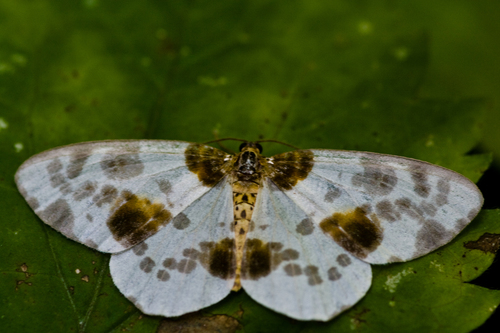
The Clouded Magpie (Abraxas sylvata) is an enchanting geometer moth native to the temperate forests of Europe and northern Asia. Named for its striking white-and-gray patterned wings that bear a resemblance to the plumage of a magpie, this moth is a master of deception. In its resting position, its mottled coloration serves as a highly effective form of mimicry, closely resembling bird droppings to deter hungry predators. This species plays an important role in forest ecosystems, with its caterpillars feeding on deciduous leaves, particularly elm, and the adults acting as pollinators and food sources for insectivorous birds and bats. It is a delight for nature enthusiasts to spot resting on the upper surfaces of leaves during the day, showcasing the quiet wonders of natural camouflage.
Lebensraum: Found in damp deciduous woodlands, wooded valleys, and parks, typically close to its larval host plants such as elm and hazel.
The Clouded Magpie is a medium-sized moth with a wingspan ranging from 3.5 to 4.4 cm. Its wings are predominantly chalky white, intricately patterned with cloudy gray-black patches and patches of yellowish-brown or metallic gold near the wing bases and margins. The thorax and abdomen are also strikingly colored with yellow and black spots. When at rest, it holds its wings flat, exposing a pattern that remarkably mimics bird droppings, an evolutionary defense mechanism known as masquerade.
Kategorie
InsektenSeltenheit
Common
Gefahr
1/5 · Sehr gering
Snaps
Mach den ersten Snap!
Despite their bright, contrasting colors, their bird-dropping mimicry is so effective that birds will often look directly at them and ignore them.
Its scientific genus name 'Abraxas' refers to a mystical word used in ancient gnostic amulets, reflecting the moth's enigmatic beauty.
The caterpillar of this species is a 'looper' or 'inchworm', moving with a distinctive looping gait by drawing its hind end up to its front legs.
The adult moth holds its wings flat to perfectly mimic bird droppings, deterring visual predators like birds.
Both larvae and adults accumulate bitter-tasting compounds from their host plants, rendering them unpalatable to many potential predators.
Females release highly specialized chemical pheromones from abdominal glands to attract mates from considerable distances through dense foliage.
As larvae, they feed voraciously on the leaves of deciduous trees, while adults feed minimally on nectar or moisture.
Altersunterschiede: Larvae eat solid leaf tissue of specific host trees, whereas adults do not possess fully functional feeding mouthparts for solid food and only occasionally sip fluids.
Ulmus glabra
Larval host plant providing nourishment for developing caterpillars
Ulmus procera
Alternative larval host plant providing foliage for caterpillars
Cyanistes caeruleus
Avian predator that feeds on both larvae and adult moths
Für dieses Objekt sind noch keine Merkmal-Badges vergeben.
Noch keine Alternativnamen vorhanden.
Sammlungen für dieses Objekt erscheinen hier, wenn weitere Themen hinzugefügt werden.
Gefahr
1/5 · Sehr gering
Noch keine besonderen Sicherheitshinweise.
Der einfachste Weg, Clouded Magpie zu bestimmen, ist die Verwendung der Naturführer-App Snappit.
123+ cm
325+ cm
0.000120003+ kg
121+ Jahre
8 km/h
As larvae, they feed voraciously on the leaves of deciduous trees, while adults feed minimally on nectar or moisture.
Found in damp deciduous woodlands, wooded valleys, and parks, typically close to its larval host plants such as elm and hazel.
Zoome hinein, um Cluster aufzulösen und zu sehen, wo dieses Objekt fotografiert wurde.
Neueste Snaps erscheinen hier, wenn neue Beobachtungen hinzukommen.