Coastal Plain Cooter
Pseudemys floridana
The Coastal Plain Cooter is a friendly turtle that loves to swim in warm waters. They have beautiful shells and can often be seen basking in the sun on logs or rocks.
Lebensraum: Wetlands
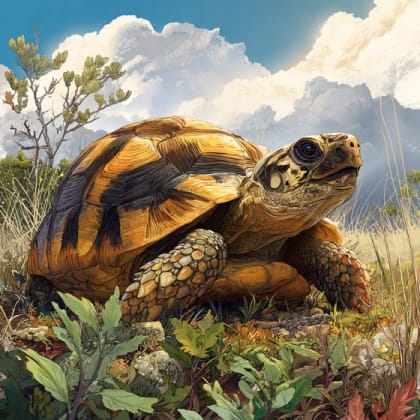
The Coastal Plain Cooter has an olive-brown to black shell with intricate yellow or orange markings. Its skin is dark with thin yellow stripes, and a distinctive 'C'-shaped mark is often seen on the second scute of its plastron.
Kategorie
ReptilienSeltenheit
Common
Gefahr
1/5 · Sehr gering
Snaps
Mach den ersten Snap!
Baby cooters are tiny, about the size of a quarter, when they first hatch from their eggs!
Their shells have special growth rings, like tree rings, that show how old they are!
They are called 'cooters' from the African word 'kuta,' meaning turtle.
When scared, young cooters hide by quickly diving underwater and burying themselves in mud.
Coastal Plain Cooter can warm its body because it basks in the sun, which helps it digest food and stay active.
Coastal Plain Cooter has excellent underwater vision that helps it spot plants and predators while submerged in murky water.
Coastal Plain Cooter can chew tough plants because it has strong, ridged jaws, helping it grind up fibrous vegetation.
Coastal Plain Cooter has a hard, domed shell that helps protect it from many predators, keeping it safe from danger.
Mainly eats various aquatic plants, making it an important herbivore in its watery home.
Altersunterschiede: Young cooters are more omnivorous, eating insects and small invertebrates, gradually shifting to an almost entirely plant-based diet as they mature.
Alligator mississippiensis
Eggs and young turtles are prey for large alligators.
Procambarus clarkii
Juveniles may opportunistically eat these common crustaceans.

Hydrilla verticillata
A primary aquatic plant food source for adult cooters.
Acer rubrum
Fallen fruits or leaves from trees near water provide food.

Ardea alba
Hatchlings and juveniles can be prey for wading birds.
Zeichnet sich durch Zehen aus, die durch eine Membran verbunden sind und normalerweise das Schwimmen erleichtern.
Soziale Tiere leben in organisierten Gruppen und kooperieren, um ihr Überleben zu sichern, beispielsweise bei der Nahrungssuche, Verteidigung und Aufzucht der Jungen.
Farbenfroh beschreibt Organismen oder Objekte, die eine große Vielfalt an leuchtenden und deutlich erkennbaren Farben aufweisen.
Dieses Merkmal kennzeichnet Lebewesen, deren Ernährung vollständig oder hauptsächlich aus pflanzlichem Material besteht.

Dieses Lebensraummerkmal kennzeichnet Arten, die in Feuchtgebieten vorkommen. Dies sind Landflächen, die dauerhaft oder saisonal mit Wasser gesättigt sind, darunter Marschland, Sümpfe und Moore.

Dieses Merkmal kennzeichnet Organismen mit einer außergewöhnlich langen Lebensspanne im Vergleich zu anderen ihrer Art.

Als gepanzert bezeichnet man Tiere, die zur Verteidigung durch eine harte, äußere Hülle oder einen Panzer geschützt sind.

Beschreibt eine Art, deren Anwesenheit und Rolle einen unverhältnismäßig großen Einfluss auf ihre Umwelt haben.

Tagaktive Tiere sind hauptsächlich bei Tageslicht aktiv und ruhen oder schlafen in der Regel nachts.

Aquatische Lebensräume umfassen Umgebungen, in denen Organismen überwiegend im Wasser leben, darunter Ozeane, Flüsse, Seen und Feuchtgebiete.
Noch keine Alternativnamen vorhanden.
Gefahr
1/5 · Sehr gering
Never try to pick up a wild turtle; it's best to watch them from a distance.
25-43 cm
2.5-6 kg
20-40 Jahre
10 km/h
Mainly eats various aquatic plants, making it an important herbivore in its watery home.
10 km/h
Wetlands
Foraging
Zoome hinein, um Cluster aufzulösen und zu sehen, wo dieses Objekt fotografiert wurde.
Neueste Snaps erscheinen hier, wenn neue Beobachtungen hinzukommen.