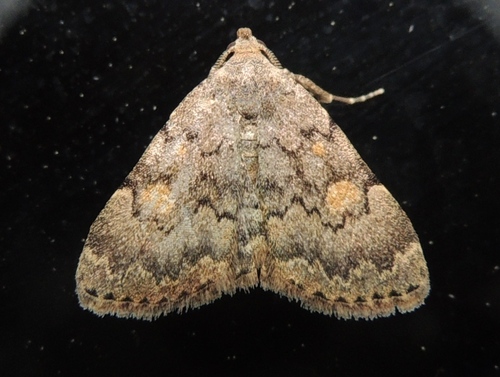


Common Idia Moth
idia aemula
The Common Idia Moth (Idia aemula) is an extremely common and ecologically vital erebid moth found throughout North America. Though small and easily overlooked, this resilient insect plays an essential role in forest ecosystems. As caterpillars, they are key decomposers, feeding extensively on dead leaf litter, lichens, and decaying organic debris on the forest floor, helping to recycle nutrients back into the soil. As adults, they serve as a critical food source for nocturnal predators like bats, spiders, and birds. Highly adaptable, they thrive in various environments ranging from deep, untouched deciduous forests to suburban backyards. Their subtle, wood-grained appearance and quiet behavior make them a classic example of underappreciated forest floor biodiversity.
Lebensraum: Found in deciduous and mixed forests, as well as suburban areas with abundant leaf litter.
The Common Idia Moth features a wingspan of 2 to 3 cm, with forewings showing a mottled grayish-brown to powdery-gray coloring. The wings are decorated with distinct, dark, wavy antemedial and postmedial lines. A defining feature is the pale yellowish or whitish reniform spot near the center of the forewing, which stands out against the darker background. The hindwings are generally lighter grayish-brown with faint banding. In a resting position, they hold their wings flat and triangular, perfectly mimicking a dead leaf.
Kategorie
InsektenSeltenheit
Common
Gefahr
1/5 · Sehr gering
Snaps
Mach den ersten Snap!
Their alternative name, 'powdered idia', comes from the fine, dust-like appearance of the scales coating their wings.
They are highly attracted to fermented sugary baits painted onto tree trunks, a common method used by researchers to survey nocturnal insects.
Unlike the caterpillars of most moth species which eat fresh green leaves, the Common Idia's offspring prefer dead, dry leaf litter.
The moth's coloration and resting posture perfectly resemble a dried, decayed leaf, allowing it to remain hidden on the forest floor.
Larvae possess specialized gut microbes that enable them to digest dry, dead plant material and fungi that other insects cannot consume.
They possess tympanic organs capable of detecting the high-frequency echolocation calls of bats, triggering evasive diving maneuvers.
Larvae primarily feed on dead, decaying leaves and fungi, while adults consume flower nectar, plant sap, and rotting fruit.
Quercus rubra
Larvae feed on the fallen, decaying leaves of this tree on the forest floor.
Myotis lucifugus
Adult moths are hunted during the night by echolocating bats.
Peromyscus leucopus
The pupae and caterpillars resting in the leaf litter are frequently preyed upon by foraging mice.
Für dieses Objekt sind noch keine Merkmal-Badges vergeben.
Noch keine Alternativnamen vorhanden.
Sammlungen für dieses Objekt erscheinen hier, wenn weitere Themen hinzugefügt werden.
Gefahr
1/5 · Sehr gering
Noch keine besonderen Sicherheitshinweise.
Der einfachste Weg, Common Idia Moth zu bestimmen, ist die Verwendung der Naturführer-App Snappit.
1+ cm
2+ cm
0.0001+ kg
1+ Jahre
12 km/h
Larvae primarily feed on dead, decaying leaves and fungi, while adults consume flower nectar, plant sap, and rotting fruit.
Found in deciduous and mixed forests, as well as suburban areas with abundant leaf litter.
Zoome hinein, um Cluster aufzulösen und zu sehen, wo dieses Objekt fotografiert wurde.
Neueste Snaps erscheinen hier, wenn neue Beobachtungen hinzukommen.














.jpg&width=800)


