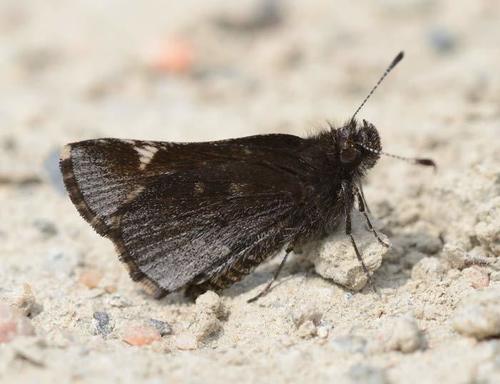


Common Roadside-Skipper
amblyscirtes vialis
The Common Roadside-Skipper (Amblyscirtes vialis) is a small, charming butterfly belonging to the skipper family Hesperiidae. Despite its unassuming, dark coloration, this insect is a delight to encounter as it darts rapidly along forest edges, sunny paths, and damp gravel roads. It gets its name from its habitual presence near dirt roads and trails, where it can often be spotted sipping minerals from moist soil. Widespread across North America, this skipper acts as an active pollinator and a key component of local grassland and woodland edge ecosystems. It exhibits a rapid, skipping flight pattern close to the ground, making it an energetic and entertaining subject for wildlife watchers.
Lebensraum: Found along wooded roadsides, damp forest paths, stream banks, and transition zones between woodlands and open meadows.
This small butterfly has a wingspan of about 2 to 3 centimeters and features a dark, blackish-brown coloration on both the upper and lower surfaces of its wings. The most distinguishing field marks are the tiny, clean white spots aligned along the outer edge of the forewing tip, contrasted against a delicately checkered black-and-white fringe. The underside of the hindwing has a grayish-violet dusting on the outer half, lacking any prominent pale spots, which helps differentiate it from other closely related skipper species.
Kategorie
InsektenSeltenheit
Common
Gefahr
1/5 · Sehr gering
Snaps
Mach den ersten Snap!
Despite its name, it is not restricted to roadsides but thrives in any sunny, disturbed transition zone between woods and fields.
Males are highly territorial and will perch on low leaves or directly on the ground to watch for passing females.
The caterpillars build protective shelters by rolling grass leaves and securing them with silk.
Flies extremely close to the ground to navigate dense vegetation and evade wind currents and predators.
Gathers on damp soil or gravel to actively extract essential sodium and minerals required for reproduction.
Uses rapid, micro-vibrations of its wings to quickly warm up its flight muscles during cool morning hours.
Caterpillars feed exclusively on various wild grasses, while adult butterflies seek out nectar from low-growing flowers.
Altersunterschiede: Larvae consume leafy green grasses, whereas adults feed on liquid nectar and damp mineralized soil.
Poa pratensis
The caterpillar of this skipper uses this grass species as its primary host plant and food source.
Misumena vatia
This sit-and-wait predator frequently ambushes adult skippers visiting flowers.
Trifolium repens
The adult skipper visits these flowers to consume nectar, aiding in the pollination of the plant.
Für dieses Objekt sind noch keine Merkmal-Badges vergeben.
Noch keine Alternativnamen vorhanden.
Sammlungen für dieses Objekt erscheinen hier, wenn weitere Themen hinzugefügt werden.
Gefahr
1/5 · Sehr gering
Noch keine besonderen Sicherheitshinweise.
Der einfachste Weg, Common Roadside-Skipper zu bestimmen, ist die Verwendung der Naturführer-App Snappit.
1-2 cm
2-3 cm
0.0001-0.0003 kg
0-1 Jahre
15 km/h
Caterpillars feed exclusively on various wild grasses, while adult butterflies seek out nectar from low-growing flowers.
Found along wooded roadsides, damp forest paths, stream banks, and transition zones between woodlands and open meadows.
Zoome hinein, um Cluster aufzulösen und zu sehen, wo dieses Objekt fotografiert wurde.
Neueste Snaps erscheinen hier, wenn neue Beobachtungen hinzukommen.









.jpg&width=800)