

Common Shiner
luxilus cornutus
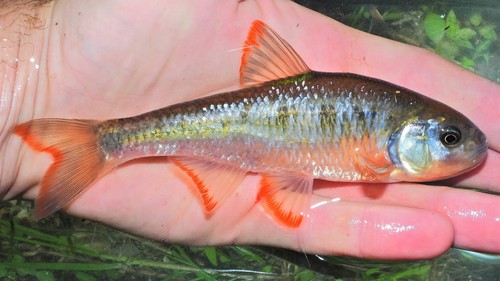
The Common Shiner is a vibrant, schooling minnow native to the clear creeks and streams of North America. Renowned for its shimmering silvery sides that flash brightly under sunlight, this fish is an essential component of freshwater ecosystems, serving as a critical food source for larger sport fish. During the spring breeding season, males undergo a dramatic transformation, developing rosy pink coloration and growing small, hard bumps on their heads called tubercles. These energetic fish are highly active and are often observed darting through shallow pools in search of insects. Their fascinating reproductive behavior, which includes laying eggs in the gravel nests built by other fish species, makes them a favorite subject for aquatic biologists and nature enthusiasts alike.
Lebensraum: Typically found in cool, clear, small to medium-sized streams and rivers with gravelly, sandy, or rocky bottoms.
A deep-bodied, laterally compressed minnow characterized by large, silvery-blue scales that are distinctly taller than they are wide. It features an olive-green back with a prominent dark dorsal stripe and brilliant silver sides that can exhibit bronze or iridescent pink highlights. Breeding males develop a distinctive pinkish-red flush on their bodies and fins, along with prominent, white, thorn-like tubercles on their snouts and heads. On average, they measure between 5 and 15 centimeters in length, with a large, terminal mouth and a deeply forked tail fin.
Kategorie
FischeSeltenheit
Common
Gefahr
1/5 · Sehr gering
Snaps
Mach den ersten Snap!
Male Common Shiners fight over nesting sites by head-butting each other using their hard, temporary head bumps called breeding tubercles.
Their scales are remarkably tall and narrow, which gives them a distinct mosaic-like flashing appearance when they twist and turn in the sunlight.
They are known as 'nest pirates' or nest associates because they lay their eggs in nests built by other fish, such as chubs or fallfish, sometimes swarming the nest in large numbers.
Common Shiners frequently spawn in the pre-constructed gravel nests of other fish species, benefiting from the host's nest defense.
During breeding season, males grow hard head nodules used for fighting rivals and stimulating females during spawning.
When injured, their skin releases an alarm substance called Schreckstoff, alerting school members to nearby predators.
They feed opportunistically on a variety of surface-dwelling and aquatic insects, small invertebrates, algae, and organic debris.
Altersunterschiede: Juveniles consume mostly microscopic plankton and algae, transitioning to larger insects and small invertebrates as they grow.
Semotilus atromaculatus
Common Shiners utilize the nests of Creek Chubs to lay their eggs, benefiting from the host's defense of the nest territory.
Micropterus dolomieu
A major predator of the Common Shiner in rocky river pools.
Megaceryle alcyon
Preys on Common Shiners by diving into shallow stream riffles to scoop them up.
Für dieses Objekt sind noch keine Merkmal-Badges vergeben.
Noch keine Alternativnamen vorhanden.
Sammlungen für dieses Objekt erscheinen hier, wenn weitere Themen hinzugefügt werden.
Gefahr
1/5 · Sehr gering
Noch keine besonderen Sicherheitshinweise.
Der einfachste Weg, Common Shiner zu bestimmen, ist die Verwendung der Naturführer-App Snappit.
5-18 cm
0.01-0.1 kg
3-6 Jahre
They feed opportunistically on a variety of surface-dwelling and aquatic insects, small invertebrates, algae, and organic debris.
Typically found in cool, clear, small to medium-sized streams and rivers with gravelly, sandy, or rocky bottoms.
Foraging
400-4000
Zoome hinein, um Cluster aufzulösen und zu sehen, wo dieses Objekt fotografiert wurde.
Neueste Snaps erscheinen hier, wenn neue Beobachtungen hinzukommen.

Iowa, US
Hier kann man sehen False Rue Anemone, Sharp-Lobed Hepatica und Common Shiner.
Führer anzeigen →

New Hampshire, US
Hier kann man sehen Common Shiner, Tree Lungwort und Bach-Elritze.
Führer anzeigen →

New Hampshire, US
Hier kann man sehen Bach-Elritze, Grünlicher Wassermolch und Elch.
Führer anzeigen →