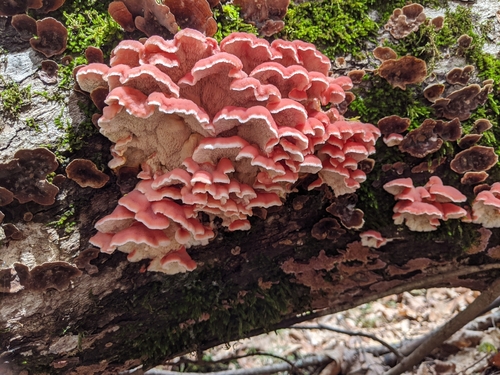


Coral-Pink Merulius
phlebia incarnata
The Coral-Pink Merulius (Phlebia incarnata) is a striking, wood-decaying fungus that graces deciduous forests with its vibrant hues. Growing as bracket-like or crust-like shelves on decaying hardwood logs, it plays a vital ecological role as a saprotrophic decomposer. This fungus is famous for producing white rot by selectively breaking down lignin, an organic polymer that gives wood its structural rigidity. In doing so, it recycles vital nutrients back into the forest soil, paving the way for new plant growth. While many fungi blend into the forest floor, the Coral-Pink Merulius demands attention with its stunning salmon, pink, or peach coloring. It is commonly encountered in Eastern North America during the damp days of late summer and autumn. Its unusual, wrinkled spore-bearing surface makes it an intriguing subject for amateur mycologists and hikers alike.
Lebensraum: Found on decaying hardwood logs and fallen branches in moist, temperate deciduous forests.
This fungus forms semi-shelved, fused, or completely flat crusts measuring 2 to 10 centimeters across. The upper surface is covered in fine, velvety hairs and showcases a brilliant coral-pink, salmon-orange, or flesh-pink color, though it fades to pale buff or tan with age. The undersurface is characterized by a network of shallow, radiating wrinkles, folds, or pore-like veins, rather than true gills, displaying a similar vibrant pink hue.
Kategorie
PilzeSeltenheit
Common
Gefahr
1/5 · Sehr gering
Snaps
Mach den ersten Snap!
It is an important contributor to the white-rot decay process, which is critical for nutrient cycling in forest ecosystems.
Its stunning coral-pink color is highly sensitive to humidity and age, fading dramatically to a dull tan when dried out.
The wrinkled underside of this fungus is referred to as merulioid, a unique texture that sits halfway between gills and pores.
Uses specialized extracellular enzymes to break down tough wood lignin, leaving behind soft white cellulose.
Can withstand dry conditions by shrinking and halting spore production, reviving rapidly when moisture returns.
Features a highly wrinkled, merulioid underside that maximizes spore-producing surface area within a compact space.
As a saprotrophic fungus, it feeds on decaying wood by releasing enzymes that break down complex plant cell walls.
Quercus rubra
Decomposes fallen wood and provides microhabitats
Bolitotherus cornutus
Feeds on the fungal tissue and uses the brackets for shelter
Für dieses Objekt sind noch keine Merkmal-Badges vergeben.
Noch keine Alternativnamen vorhanden.
Sammlungen für dieses Objekt erscheinen hier, wenn weitere Themen hinzugefügt werden.
Gefahr
1/5 · Sehr gering
Noch keine besonderen Sicherheitshinweise.
Der einfachste Weg, Coral-Pink Merulius zu bestimmen, ist die Verwendung der Naturführer-App Snappit.
2-10 cm
0.01-0.1 kg
1-5 Jahre
As a saprotrophic fungus, it feeds on decaying wood by releasing enzymes that break down complex plant cell walls.
Found on decaying hardwood logs and fallen branches in moist, temperate deciduous forests.
Zoome hinein, um Cluster aufzulösen und zu sehen, wo dieses Objekt fotografiert wurde.
Neueste Snaps erscheinen hier, wenn neue Beobachtungen hinzukommen.











