

Corixini
corixini
Meet the active and highly social water boatmen of the tribe Corixini, a fascinating group of aquatic insects that bring life to freshwater ecosystems across the globe. Unlike many of their water-dwelling cousins, water boatmen swim right-side up, utilizing their paddle-like hind legs to gracefully row through quiet waters. They are unique among aquatic bugs because they are mostly non-predatory, acting as essential vacuum cleaners of ponds and lakes. These tiny insects are crucial players in aquatic food webs. They serve as a primary food source for fish and amphibians while helping to keep algal growth under control. Their presence is a sign of a vibrant, healthy aquatic habitat, making them a delight for pond-watchers and nature enthusiasts to observe.
Lebensraum: They thrive in shallow, slow-moving or stagnant freshwaters such as ponds, marshes, lakes, and temporary pools containing rich aquatic vegetation.
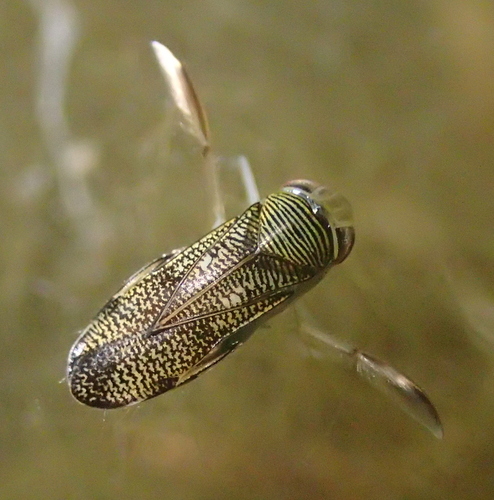
Members of the Corixini tribe are characterized by their flattened, elongate-oval bodies that typically measure between 0.3 and 1.2 centimeters in length. They exhibit a mottled pattern of dark browns and greys interspersed with fine, yellow transverse lines across their backs, providing excellent camouflage against muddy pond bottoms. Their most distinctive features are their highly specialized legs: the short front legs are modified into scoop-shaped paddles called palae, while the long hind legs are fringed with stiff hairs, functioning perfectly as oars to propel them through the water.
Kategorie
InsektenSeltenheit
Common
Gefahr
1/5 · Sehr gering
Snaps
Mach den ersten Snap!
In some cultures, such as in Mexico, the eggs of water boatmen are harvested from aquatic plants and consumed as a delicacy known as ahuautle.
They are capable flyers and will take off en masse from drying pools to locate new freshwater habitats, often guided by the polarized light reflecting off water surfaces.
They carry their own oxygen tank in the form of a bubble trapped against their abdomen, which dynamically extracts dissolved oxygen from the surrounding water.
Unlike backswimmers, water boatmen swim right-side up and cannot give humans a painful bite.
They trap a thin layer of air against their bodies using microscopic hairs, creating a physical gill that allows them to absorb oxygen directly from the water.
Their hind legs are highly adapted with a dense fringe of swimming hairs that fan out on the power stroke and collapse on the return, offering maximum swimming efficiency.
Males can rub their front legs against their head or proboscis to create surprisingly loud acoustic signals that travel through the water to attract mates.
They primarily feed by scraping algae and organic debris from underwater surfaces, supplemented by consuming microscopic aquatic organisms.
Lepomis macrochirus
Preyed upon extensively by insectivorous fish in shallow lake littoral zones.
Lymnaea stagnalis
Competes for algae, diatoms, and organic biofilms on aquatic vegetation.
Culex pipiens
Occasionally hunts and consumes larvae to supplement its plant-based diet.
Für dieses Objekt sind noch keine Merkmal-Badges vergeben.
Noch keine Alternativnamen vorhanden.
Sammlungen für dieses Objekt erscheinen hier, wenn weitere Themen hinzugefügt werden.
Gefahr
1/5 · Sehr gering
Noch keine besonderen Sicherheitshinweise.
Der einfachste Weg, Corixini zu bestimmen, ist die Verwendung der Naturführer-App Snappit.
0+ cm
0+ cm
0+ kg
1+ Jahre
3 km/h
They primarily feed by scraping algae and organic debris from underwater surfaces, supplemented by consuming microscopic aquatic organisms.
They thrive in shallow, slow-moving or stagnant freshwaters such as ponds, marshes, lakes, and temporary pools containing rich aquatic vegetation.
Zoome hinein, um Cluster aufzulösen und zu sehen, wo dieses Objekt fotografiert wurde.
Neueste Snaps erscheinen hier, wenn neue Beobachtungen hinzukommen.














%2C_Fort_du_Loc%27h%2C_Guidel%2C_Brittany%2C_France_(19900725286)_(cropped).jpg&width=800)




