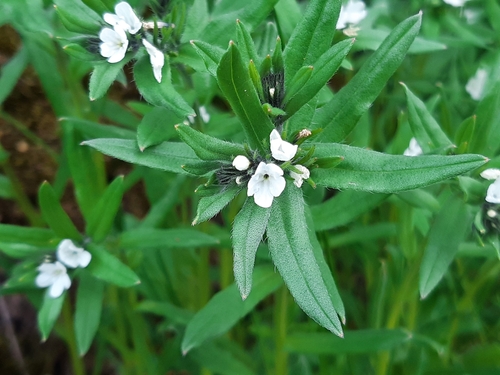


Corn Gromwell
buglossoides arvensis
Corn Gromwell (Buglossoides arvensis) is a hardy, annual herbaceous plant native to Europe and Asia, now widely naturalized across North America and Australia. Traditionally found growing alongside cereal crops, this modest member of the borage family (Boraginaceae) is recognized by its small, funnel-shaped white flowers and stiffly hairy stems. While once dismissed purely as an agricultural weed, Corn Gromwell has recently captured the attention of nutritional science due to the exceptionally high concentration of beneficial omega-3 fatty acids found in its stony seeds. Its resilient nature allows it to colonize disturbed soils, farm borders, and dry waste sites, making it a common but often overlooked participant in rural and urban ecosystems alike.
Lebensraum: Typically found in cultivated arable fields, farm borders, dry waste ground, and along sunny roadsides.
Corn Gromwell is an upright herb growing up to 50 cm tall, characterized by its rough, bristly stems and lance-shaped, grayish-green leaves covered in flat, stiff hairs. In late spring and summer, it produces tiny, inconspicuous white or pale cream flowers, roughly 3 to 4 mm in diameter, with five distinct lobes nestled in the upper leaf axils. Following flowering, the plant produces distinctive, hard, wrinkled, brownish-gray nutlets that closely resemble small pebbles.
Kategorie
PflanzenSeltenheit
Common
Gefahr
1/5 · Sehr gering
Snaps
Mach den ersten Snap!
Corn Gromwell seed oil is a highly sought-after plant source of stearidonic acid (SDA), an omega-3 fatty acid that the human body can efficiently convert into EPA.
Historically, the red pigment extracted from the outer layers of its roots was used as a rustic, cheap cosmetic rouge.
The hard, stony seeds of the plant resemble tiny gravel stones, which inspired the genus name Buglossoides (formerly grouped under Lithospermum, meaning 'stone-seed').
Produces highly mineralized seeds rich in calcium and silica, rendering them exceptionally hard and durable against environmental stressors and seed predators.
Entirely covered in stiff, appressed bristly hairs that deter crawling herbivores and significantly reduce moisture loss in dry environments.
Seeds can remain dormant but viable within the soil for several years, germinating opportunistically when the soil is disturbed.
As a photosynthetic plant, Corn Gromwell manufactures its own organic compounds using sunlight, water, carbon dioxide, and essential soil minerals.
Apis mellifera
Visits the small flowers to gather nectar and pollen, acting as an effective pollinator.
Brassicogethes aeneus
Feeds on the developing pollen grains and flower buds of the plant, occasionally reducing seed set.
Für dieses Objekt sind noch keine Merkmal-Badges vergeben.
Noch keine Alternativnamen vorhanden.
Sammlungen für dieses Objekt erscheinen hier, wenn weitere Themen hinzugefügt werden.
Gefahr
1/5 · Sehr gering
Noch keine besonderen Sicherheitshinweise.
Der einfachste Weg, Corn Gromwell zu bestimmen, ist die Verwendung der Naturführer-App Snappit.
10-50 cm
1 Jahre
As a photosynthetic plant, Corn Gromwell manufactures its own organic compounds using sunlight, water, carbon dioxide, and essential soil minerals.
Typically found in cultivated arable fields, farm borders, dry waste ground, and along sunny roadsides.
Zoome hinein, um Cluster aufzulösen und zu sehen, wo dieses Objekt fotografiert wurde.
Neueste Snaps erscheinen hier, wenn neue Beobachtungen hinzukommen.




.jpg&width=800)









