

Cowpen Daisy
verbesina encelioides
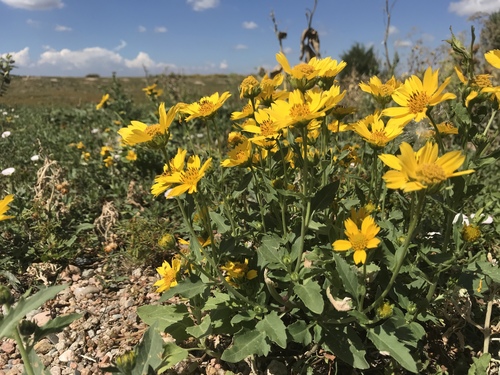
The Cowpen Daisy (Verbesina encelioides) is a resilient, golden-bloomed annual wildflower native to the Americas. Often colonizing disturbed grounds, pastures, and roadsides, this tough plant is named for its fondness for fertile, trampled soils like those of livestock enclosures. It is highly valued by entomologists and gardeners alike for its exceptional ability to attract a diverse array of pollinators, transforming dry, open landscapes into buzzing havens for bees, butterflies, and beetles during the hottest months of the year.
Lebensraum: Found in disturbed soils, roadsides, pastures, fields, and sandy coastal areas across arid and semi-arid regions.
This plant typically grows 30 to 150 cm tall, displaying coarse, grayish-green, triangular or lance-shaped leaves with deeply toothed margins. The entire plant is covered in fine, whitish hairs, giving it a soft, dusty, or velvety appearance. Its bright yellow, daisy-like composite flower heads measure about 2 to 5 cm across, featuring distinctive three-toothed tips on the outer ray florets surrounding a dense golden center.
Kategorie
PflanzenSeltenheit
Common
Gefahr
1/5 · Sehr gering
Snaps
Mach den ersten Snap!
Native American tribes traditionally used crushed parts of the plant to treat skin ailments and soothe insect stings.
The common name 'Cowpen Daisy' arises from its affinity for highly disturbed, nitrogen-rich soils, especially around livestock pens and holding areas.
While highly toxic to sheep, goats, and cattle, its flowers are completely harmless and incredibly attractive to migrating Monarch butterflies.
Exudes chemicals from its roots and decaying leaves that inhibit the germination and growth of neighboring plant species, helping it dominate open soil.
Utilizes dense, light-colored leaf hairs to reflect excess sunlight, reduce wind exposure, and conserve water in dry environments.
Produces galegine, a toxic nitrogenous compound that deters mammalian herbivores from grazing on its foliage.
As a photosynthetic plant, the Cowpen Daisy generates its own organic compounds using sunlight, carbon dioxide, water, and essential mineral nutrients absorbed from the soil.
Chlosyne lacinia
The caterpillar of this butterfly relies heavily on the leaves of the cowpen daisy as a primary food source.
Apis mellifera
Bees actively collect nectar and pollen from the golden flower heads, serving as key pollinators.
Ovis aries
May ingest the toxic leaves in overgrazed pastures, leading to lethal lung congestion.
Für dieses Objekt sind noch keine Merkmal-Badges vergeben.
Noch keine Alternativnamen vorhanden.
Sammlungen für dieses Objekt erscheinen hier, wenn weitere Themen hinzugefügt werden.
Gefahr
1/5 · Sehr gering
Noch keine besonderen Sicherheitshinweise.
Der einfachste Weg, Cowpen Daisy zu bestimmen, ist die Verwendung der Naturführer-App Snappit.
30-150 cm
1 Jahre
As a photosynthetic plant, the Cowpen Daisy generates its own organic compounds using sunlight, carbon dioxide, water, and essential mineral nutrients absorbed from the soil.
Found in disturbed soils, roadsides, pastures, fields, and sandy coastal areas across arid and semi-arid regions.
Photosynthesis
7-21 Tage
Zoome hinein, um Cluster aufzulösen und zu sehen, wo dieses Objekt fotografiert wurde.
Neueste Snaps erscheinen hier, wenn neue Beobachtungen hinzukommen.













