






crane-fly orchid
Tipularia discolor
The crane-fly orchid is a special flower that looks like a tiny crane in flight! It has beautiful greenish flowers that bloom in the spring, often hiding in the woods.
Lebensraum: Forests
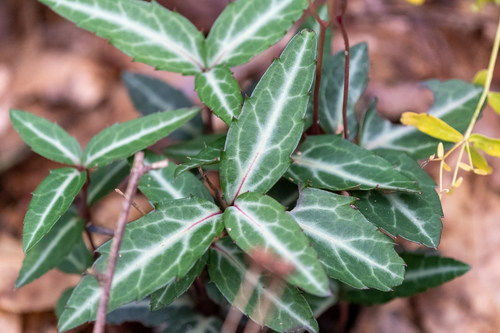
The crane-fly orchid has a single, ribbed leaf that is dark green on top and rich purple underneath. Its tall, slender stalk bears small, greenish-brown flowers with thin petals that resemble tiny crane-flies.
Kategorie
PflanzenSeltenheit
Common
Gefahr
1/5 · Sehr gering
Snaps
Mach den ersten Snap!
Its scientific name, discolor, means "two colors" because its leaf is green on top and purple underneath!
Some people say its tiny flowers smell like sweet apples or spicy cloves!
This sneaky orchid often disappears in spring, leaving no trace until its flower stalk pops up in summer!
Unlike many plants, it grows its leaf in the fall and keeps it all winter long!
The crane-fly orchid grows a single leaf in fall that survives all winter, soaking up sun when tree leaves are gone!
Its small, greenish-brown flowers open at night and release a sweet scent to guide long-tongued moths in the darkness.
This orchid has a hidden chain of round, starchy tubers beneath the soil, storing food for years like a secret pantry!
Agrotis ipsilon
Moth pollinates orchid by visiting its night-blooming flowers.
Tulasnella calospora
Fungus helps orchid absorb nutrients from the soil for survival.
Odocoileus virginianus
Deer may browse on the orchid's leaves or flower stalks.
Blütenpflanzen sind alle Pflanzen, die als Teil ihres Fortpflanzungszyklus Blüten bilden.
Frühlingsblüher bilden ihre Blüten im Frühjahr und kündigen oft das Ende des Winters und den Beginn neuen Wachstums an.
Schattenverträgliche Pflanzen sind an das Wachstum und Gedeihen in Bereichen mit wenig Licht angepasst und benötigen weniger direkte Sonneneinstrahlung.
Beschreibt Pflanzen, die für eine Vielzahl von bestäubenden Organismen besonders attraktiv und nützlich sind.

Beschreibt eine Beziehung zwischen zwei verschiedenen Arten, die eng zusammenleben, was oft einer oder beiden zugutekommt.

Dieses Merkmal kennzeichnet Organismen mit einer außergewöhnlich langen Lebensspanne im Vergleich zu anderen ihrer Art.

Waldlebensräume sind terrestrische Lebensräume, die von dichtem Baumbestand dominiert werden und eine große Vielfalt an Pflanzen- und Tierarten beherbergen.

Der Status 'Stark gefährdet' bedeutet, dass eine Art in naher Zukunft einem sehr hohen Risiko ausgesetzt ist, in freier Wildbahn auszusterben.
Noch keine Alternativnamen vorhanden.
Gefahr
1/5 · Sehr gering
Always look at flowers from a distance and never pick them without permission.
30-60 cm
10-20 cm
1-1.5 cm
Sommer
Nein
Keine
Mehrjährig
Insekten
Zoome hinein, um Cluster aufzulösen und zu sehen, wo dieses Objekt fotografiert wurde.
Neueste Snaps erscheinen hier, wenn neue Beobachtungen hinzukommen.
.jpg)
Virginia, US
Hier kann man sehen Kanadareiher, Fan Clubmoss und Kanadagans.
Führer anzeigen →

North Carolina, US
Hier kann man sehen Common Watersnake, Fowler-Kröte und Fire Pink.
Führer anzeigen →

Tennessee, US
Hier kann man sehen American Coot, Crane-Fly Orchid und Pied-Billed Grebe.
Führer anzeigen →
Virginia, US
Hier kann man sehen Striped Wintergreen, Christmas Fern und Autumn Olive.
Führer anzeigen →














