

Crowded Parchment
stereum complicatum
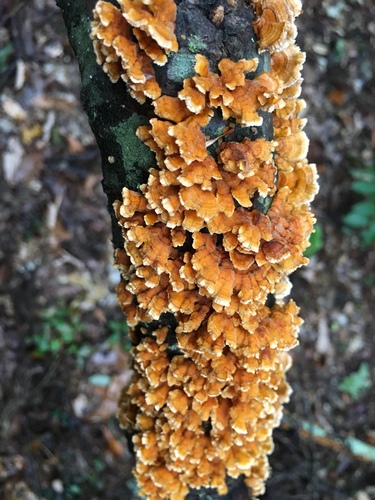
The Crowded Parchment (Stereum complicatum) is a beautiful and ubiquitous crust fungus that populates the deciduous forests of North America. Renowned for its vibrant shades of orange, yellow, and buff, this non-gilled bracket fungus grows in tight, overlapping, and often fused clusters on decaying hardwood. It plays an essential role in forest ecosystems as a saprobe, actively recycling nutrients by breaking down complex organic compounds like lignin and cellulose from fallen branches and logs. Unlike many soft, fleshy mushrooms, the tough, paper-thin structure of the Crowded Parchment allows it to withstand various weather extremes. It can shrivel and go dormant during dry spells, only to rehydrate and continue sporulating when rains return. This resilience makes it a reliable find for woodland explorers throughout the year.
Lebensraum: Typically found on decaying logs, fallen branches, and stumps of hardwood trees, especially oaks, in temperate deciduous forests.
This fungus features small, thin, fan-shaped to semi-circular caps that measure 1 to 4 cm in width, though they frequently fuse into extensive, wavy, crowded shelves. The upper surface is finely hairy or velvety and displays striking concentric bands of bright orange, saffron, and brownish-orange, which fade to a dull buff or greyish-white as they age. The underside is completely smooth, lacking pores or gills, and typically presents a bright orange to pale yellowish-buff coloration. When fresh, the margins are often brightly colored and distinctly wavy.
Kategorie
PilzeSeltenheit
Common
Gefahr
1/5 · Sehr gering
Snaps
Mach den ersten Snap!
Despite looking somewhat like a small Turkey Tail fungus, Crowded Parchment has a completely smooth underside with no visible pores or gills.
In dry weather, this fungus curls inward and fades in color, performing a spectacular color transformation back to bright orange within minutes of getting wet.
Its scientific name, 'complicatum', refers to the folded, tangled, or 'complicated' way the caps crowd and fuse together.
Can dry out completely during periods of drought, becoming brittle, and quickly revive to release spores upon rehydration.
Secretes powerful extracellular enzymes that break down tough lignin and cellulose in dead wood, facilitating nutrient recycling.
Individual fruiting bodies can fuse together seamlessly, sharing resources to cover massive surface areas on host logs.
As a saprotrophic fungus, it feeds on decaying organic matter, specifically decomposing dead hardwood limbs, logs, and stumps.
Quercus alba
Grows primarily as a saprobe decomposing dead wood from this host tree.
Megalodacne heros
Larvae of this beetle feed on the fruiting bodies and spores of the fungus.
Trametes versicolor
Competes with other wood-decaying bracket fungi for space and nutrients on the same hardwood logs.
Für dieses Objekt sind noch keine Merkmal-Badges vergeben.
Noch keine Alternativnamen vorhanden.
Sammlungen für dieses Objekt erscheinen hier, wenn weitere Themen hinzugefügt werden.
Gefahr
1/5 · Sehr gering
Noch keine besonderen Sicherheitshinweise.
Der einfachste Weg, Crowded Parchment zu bestimmen, ist die Verwendung der Naturführer-App Snappit.
1-4 cm
1-2 Jahre
As a saprotrophic fungus, it feeds on decaying organic matter, specifically decomposing dead hardwood limbs, logs, and stumps.
Typically found on decaying logs, fallen branches, and stumps of hardwood trees, especially oaks, in temperate deciduous forests.
Zoome hinein, um Cluster aufzulösen und zu sehen, wo dieses Objekt fotografiert wurde.
Neueste Snaps erscheinen hier, wenn neue Beobachtungen hinzukommen.