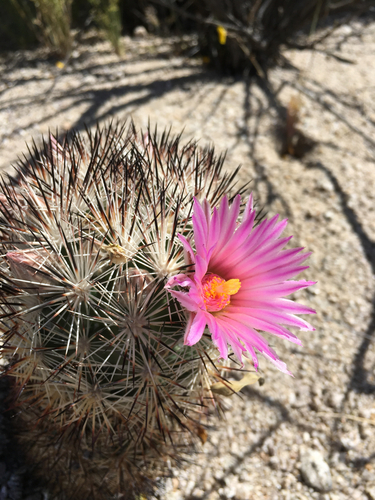


Cushion Foxtail Cactus
escobaria alversonii
The Cushion Foxtail Cactus, Escobaria alversonii, is a charming and resilient native cactus of the southwestern United States. Known for its small, clustered stems and distinctive spination, it forms low-growing cushions that blend seamlessly into its arid environment. This species is a testament to the harsh beauty of desert flora, thriving in dry, rocky soils where few other plants can survive. Its attractive pink to magenta flowers, which bloom in spring, add a splash of color to the otherwise stark landscape, making it a beloved sight for nature enthusiasts and a vital component of its ecosystem.
Lebensraum: Found in dry, rocky soils, often on mesas, hillsides, and limestone outcrops in desert grasslands and pinyon-juniper woodlands.
This cactus typically forms dense, cushion-like clusters up to 15 cm tall and 30 cm wide. Individual stems are usually globular to cylindrical, 2-5 cm in diameter, and covered in prominent tubercles. Each tubercle bears a white, woolly areole from which numerous sharp, white to reddish-brown spines emerge, often obscuring the stem beneath. The radial spines are bristly and numerous, while central spines are thicker and fewer, often with hooked tips. Flowers are funnel-shaped, typically pink to magenta, appearing near the apex of the stems in spring, followed by small, red, berry-like fruits.
Kategorie
PflanzenSeltenheit
Common
Gefahr
1/5 · Sehr gering
Snaps
Mach den ersten Snap!
Despite its formidable spines, the small, red, berry-like fruits of the Cushion Foxtail Cactus are edible and often consumed by various desert wildlife, contributing to seed dispersal.
Like many cacti, Escobaria alversonii utilizes a specialized photosynthetic pathway called Crassulacean Acid Metabolism (CAM) to conserve water by opening its stomata only at night to absorb carbon dioxide.
The 'Foxtail' in its common name refers to the bristly appearance of its dense spines, which resemble a fox's tail.
This cactus possesses highly specialized succulent stems that store water, allowing it to survive extended periods of drought in its arid environment. Its reduced surface area and waxy cuticle also minimize water loss through transpiration.
Dense, sharp spines provide effective protection against most herbivores attempting to consume its water-rich tissues. The spines also help shade the plant body, reducing heat stress and water evaporation.
The tendency to grow in tight clusters helps to create a microclimate, reducing water evaporation from the soil surface and protecting individual stems from extreme temperatures and harsh winds.
The Cushion Foxtail Cactus produces its own food through photosynthesis, utilizing sunlight, carbon dioxide from the air, and water and minerals absorbed from the soil.
Apis mellifera
Pollinates flowers during blooming season.
Sylvilagus audubonii
Consumes fruits and sometimes succulent stems.
Peromyscus eremicus
Consumes fruits, aiding in seed dispersal.
Für dieses Objekt sind noch keine Merkmal-Badges vergeben.
Noch keine Alternativnamen vorhanden.
Sammlungen für dieses Objekt erscheinen hier, wenn weitere Themen hinzugefügt werden.
Gefahr
1/5 · Sehr gering
Noch keine besonderen Sicherheitshinweise.
Der einfachste Weg, Cushion Foxtail Cactus zu bestimmen, ist die Verwendung der Naturführer-App Snappit.
5-15 cm
0.1-1 kg
10-30 Jahre
The Cushion Foxtail Cactus produces its own food through photosynthesis, utilizing sunlight, carbon dioxide from the air, and water and minerals absorbed from the soil.
Found in dry, rocky soils, often on mesas, hillsides, and limestone outcrops in desert grasslands and pinyon-juniper woodlands.
50-500
Zoome hinein, um Cluster aufzulösen und zu sehen, wo dieses Objekt fotografiert wurde.
Neueste Snaps erscheinen hier, wenn neue Beobachtungen hinzukommen.











