

Cutleaf Grapefern
sceptridium dissectum
The Cutleaf Grapefern (Sceptridium dissectum) is a fascinating, primitive fern native to the woodlands of eastern North America. Belonging to the ancient adder's-tongue family, this low-growing perennial stands out for its unusual life cycle and striking seasonal changes. Unlike typical ferns that display lush green fronds only during the warm spring and summer months, the sterile leaf of the Cutleaf Grapefern persists throughout the cold winter, often undergoing a spectacular transformation to a rich bronze or reddish-purple hue. This winter evergreen habit makes it an exciting find for cold-weather hikers. The plant is dimorphic, featuring a highly dissected, lacy vegetative frond that grows close to the ground, and a tall, separate, erect fertile stalk resembling a tiny cluster of green grapes, which releases wind-dispersed spores in late autumn. It plays a subtle yet vital role in forest ecosystems, relying on complex symbiotic partnerships beneath the soil surface to thrive.
Lebensraum: Found in moist, acidic deciduous woodlands, second-growth forests, old overgrown fields, and shaded thickets, often growing among leaf litter.
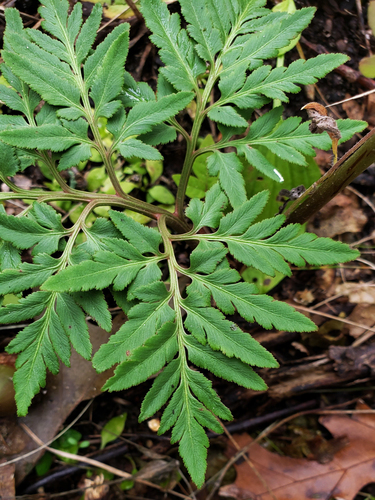
This small fern features a highly divided, lacy, triangular sterile blade that sits on a short stalk close to the ground, measuring 10 to 40 cm tall. The segments of the leaf are deeply cut with pointed, sharp-toothed margins, giving it a distinctive 'cutleaf' texture. During summer, the leaves are a deep green, but they turn bronze-red or purple after the first winter frosts. Rising from the same base is a taller, fleshy fertile stalk that ends in a branched, grape-like cluster of yellow-green sporangia which eventually turn brown when releasing spores.
Kategorie
PflanzenSeltenheit
Common
Gefahr
1/5 · Sehr gering
Snaps
Mach den ersten Snap!
Because it relies so heavily on undisturbed underground fungal networks, this fern is highly sensitive to soil disruption and rarely survives transplantation.
Its common name 'grapefern' comes from the rounded, grape-like appearance of its spore-bearing structures called sporangia.
The bronze coloration of its winter leaves acts like a natural solar heater, absorbing extra warmth from weak winter sunlight.
The sterile fronds undergo a chemical shift in late autumn, turning from bright green to bronze-purple to better absorb winter warmth and resist freezing temperatures.
The microscopic spores require an obligate symbiotic relationship with subterranean mycorrhizal fungi to germinate and nourish the non-photosynthetic gametophyte.
It splits its energy between a low-growing vegetative leaf for light capture and a highly elevated, separate fertile stalk designed to maximize wind dispersal of spores.
As a photosynthetic plant, the mature sporophyte produces its own energy using sunlight, carbon dioxide, water, and soil minerals, while its subterranean stages depend on mycorrhizal fungi.
Altersunterschiede: The juvenile gametophyte stage lives underground without sunlight, absorbing nutrients entirely from soil fungi, whereas the mature sporophyte relies on photosynthesis.
Glomus intraradices
Provides a symbiotic fungal network necessary for spore germination and gametophyte development.
Odocoileus virginianus
Occasionally browses the evergreen sterile leaves during winter when food is scarce.
Herpetogramma aeglealis
Caterpillars feed on the sterile fronds of various woodland ferns.
Für dieses Objekt sind noch keine Merkmal-Badges vergeben.
Noch keine Alternativnamen vorhanden.
Sammlungen für dieses Objekt erscheinen hier, wenn weitere Themen hinzugefügt werden.
Gefahr
1/5 · Sehr gering
Noch keine besonderen Sicherheitshinweise.
Der einfachste Weg, Cutleaf Grapefern zu bestimmen, ist die Verwendung der Naturführer-App Snappit.
10-40 cm
5-20 Jahre
As a photosynthetic plant, the mature sporophyte produces its own energy using sunlight, carbon dioxide, water, and soil minerals, while its subterranean stages depend on mycorrhizal fungi.
Found in moist, acidic deciduous woodlands, second-growth forests, old overgrown fields, and shaded thickets, often growing among leaf litter.
Zoome hinein, um Cluster aufzulösen und zu sehen, wo dieses Objekt fotografiert wurde.
Neueste Snaps erscheinen hier, wenn neue Beobachtungen hinzukommen.