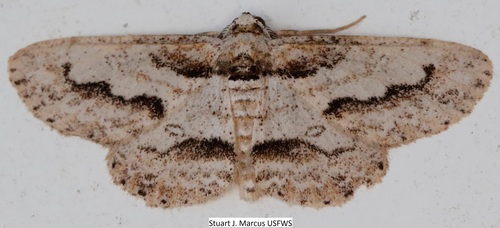


Cypress Gray
iridopsis pergracilis
The Cypress Gray (Iridopsis pergracilis) is a fascinating geometrid moth native to the wetlands and swamp forests of the southeastern United States. Closely tied to its namesake host plants, the bald cypress and pond cypress, this moth is a master of disguise. As caterpillars, they resemble small twigs, looping elegantly along cypress needles. As adults, they transform into cryptic beauties that blend seamlessly into the bark of swamp trees. They play a vital role in their native ecosystems, serving as an important food source for nesting birds and insectivorous reptiles while participating in natural forest dynamics.
Lebensraum: Found in cypress swamps, wet woodlands, and riparian zones throughout the southeastern United States.
Adult Cypress Grays feature a wingspan of 2.5 to 3.8 cm, with a highly cryptic wing pattern composed of mottled grays, whites, and dark brown lines. The forewings and hindwings have wavy postmedial and antemedial lines that perfectly mimic the texture, lichens, and cracks of cypress bark. When at rest, they spread their wings flat against a surface to obscure their silhouette. The caterpillars are typical inchworms—slender, brownish-green, and resembling the twigs and leaf stalks of their host trees.
Kategorie
InsektenSeltenheit
Common
Gefahr
1/5 · Sehr gering
Snaps
Mach den ersten Snap!
Like other geometrid moths, the caterpillars of the Cypress Gray are 'inchworms', moving with a looping gait because they lack mid-abdominal prolegs.
Severe local outbreaks of Cypress Gray caterpillars can occasionally defoliate large stands of pond cypress in Florida, though the trees typically flush new leaves and recover.
Their flight season is continuous in the warmest parts of Florida, with multiple overlapping generations emerging throughout the year.
Adults possess intricate wing patterns that mimic lichen and bark, allowing them to disappear entirely from predators when resting flat against tree trunks.
The larvae (caterpillars) can hold their bodies rigid at an angle from branches, perfectly imitating cypress twigs to avoid detection by birds.
The moth presses its wings incredibly flat against the bark surface to prevent casting a shadow, which would otherwise give away its location.
Larvae feed exclusively on the foliage of cypress trees, while adults primarily sip flower nectar or do not feed extensively during their short adult lifespan.
Altersunterschiede: Larvae are strictly defoliators feeding on cypress needles, whereas adults feed exclusively on liquid nectar if they feed at all.
Taxodium distichum
Provides critical larval food source and host tree support.
Anolis carolinensis
Preys on the adult moths and caterpillars found on tree trunks.
Poecile carolinensis
Forages in swamp canopies and gleans caterpillars from foliage.
Für dieses Objekt sind noch keine Merkmal-Badges vergeben.
Noch keine Alternativnamen vorhanden.
Sammlungen für dieses Objekt erscheinen hier, wenn weitere Themen hinzugefügt werden.
Gefahr
1/5 · Sehr gering
Noch keine besonderen Sicherheitshinweise.
Der einfachste Weg, Cypress Gray zu bestimmen, ist die Verwendung der Naturführer-App Snappit.
1+ cm
2+ cm
0+ kg
0+ Jahre
15 km/h
Larvae feed exclusively on the foliage of cypress trees, while adults primarily sip flower nectar or do not feed extensively during their short adult lifespan.
Found in cypress swamps, wet woodlands, and riparian zones throughout the southeastern United States.
Zoome hinein, um Cluster aufzulösen und zu sehen, wo dieses Objekt fotografiert wurde.
Neueste Snaps erscheinen hier, wenn neue Beobachtungen hinzukommen.


















