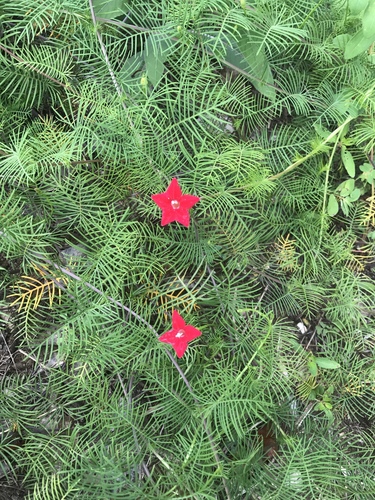


Cypress Vine
ipomoea quamoclit
The Cypress Vine (Ipomoea quamoclit) is an enchanting, fast-growing annual climbing vine famous for its delicate, fern-like foliage and brilliant, star-shaped flowers. Belonging to the morning glory family, this vigorous climber twines effortlessly around trellises, fences, and neighboring plants, adding vertical drama to any landscape. It is highly valued by gardeners not only for its aesthetic appeal but also for its remarkable ability to attract vital pollinators.
Lebensraum: Found in disturbed open fields, forest edges, roadsides, and cultivated garden spaces, typically thriving in warm, sun-drenched tropical and temperate regions.
This vine features deeply dissected, thread-like green leaves that resemble feathery cypress needles, creating a light, airy canopy. Its striking flowers are tubular and flare open into five-pointed stars, typically measuring about 2 to 3 centimeters across. While bright scarlet red is the most common color, pink and white variations also occur. The slender stems climb to heights of 1 to 6 meters by twining tightly around any available support.
Kategorie
PflanzenSeltenheit
Common
Gefahr
1/5 · Sehr gering
Snaps
Mach den ersten Snap!
Despite its common name, it is a true member of the morning glory family and not closely related to true cypress trees.
In India, it is sometimes called 'Kamalata' or 'Love's Vine', carrying romantic cultural significance in local folklore.
The seeds of this plant contain small amounts of hallucinogenic morning glory alkaloids and are toxic if ingested by pets or humans.
Uses fast-growing, highly sensitive twining stems to wrap around structures and other plants, ascending rapidly to claim light.
Produces sweet, deeply located nectar that specifically lures long-beaked hummingbirds and specialized moths for pollination.
Possesses highly divided leaves that minimize wind drag and physical damage while maximizing light absorption in crowded environments.
As a photosynthetic plant, the Cypress Vine synthesizes its own organic compounds using sunlight, carbon dioxide, water, and soil minerals.
Archilochus colubris
Feeds on nectar and serves as the primary pollinator for the flowers.
Agrius cingulata
Larvae of this moth feed on the foliage of Cypress Vine.
Apis mellifera
Visits flowers to gather pollen and assist in pollination.
Für dieses Objekt sind noch keine Merkmal-Badges vergeben.
Noch keine Alternativnamen vorhanden.
Sammlungen für dieses Objekt erscheinen hier, wenn weitere Themen hinzugefügt werden.
Gefahr
1/5 · Sehr gering
Noch keine besonderen Sicherheitshinweise.
Der einfachste Weg, Cypress Vine zu bestimmen, ist die Verwendung der Naturführer-App Snappit.
100-600 cm
1 Jahre
As a photosynthetic plant, the Cypress Vine synthesizes its own organic compounds using sunlight, carbon dioxide, water, and soil minerals.
Found in disturbed open fields, forest edges, roadsides, and cultivated garden spaces, typically thriving in warm, sun-drenched tropical and temperate regions.
Photosynthesis
7-21 Tage
Zoome hinein, um Cluster aufzulösen und zu sehen, wo dieses Objekt fotografiert wurde.
Neueste Snaps erscheinen hier, wenn neue Beobachtungen hinzukommen.









.jpg&width=800)


